Failed ACH Return Code Handling in Contractor Payment Pipelines
Ignoring ACH return codes costs contractors pay speed and operators compliance violations.
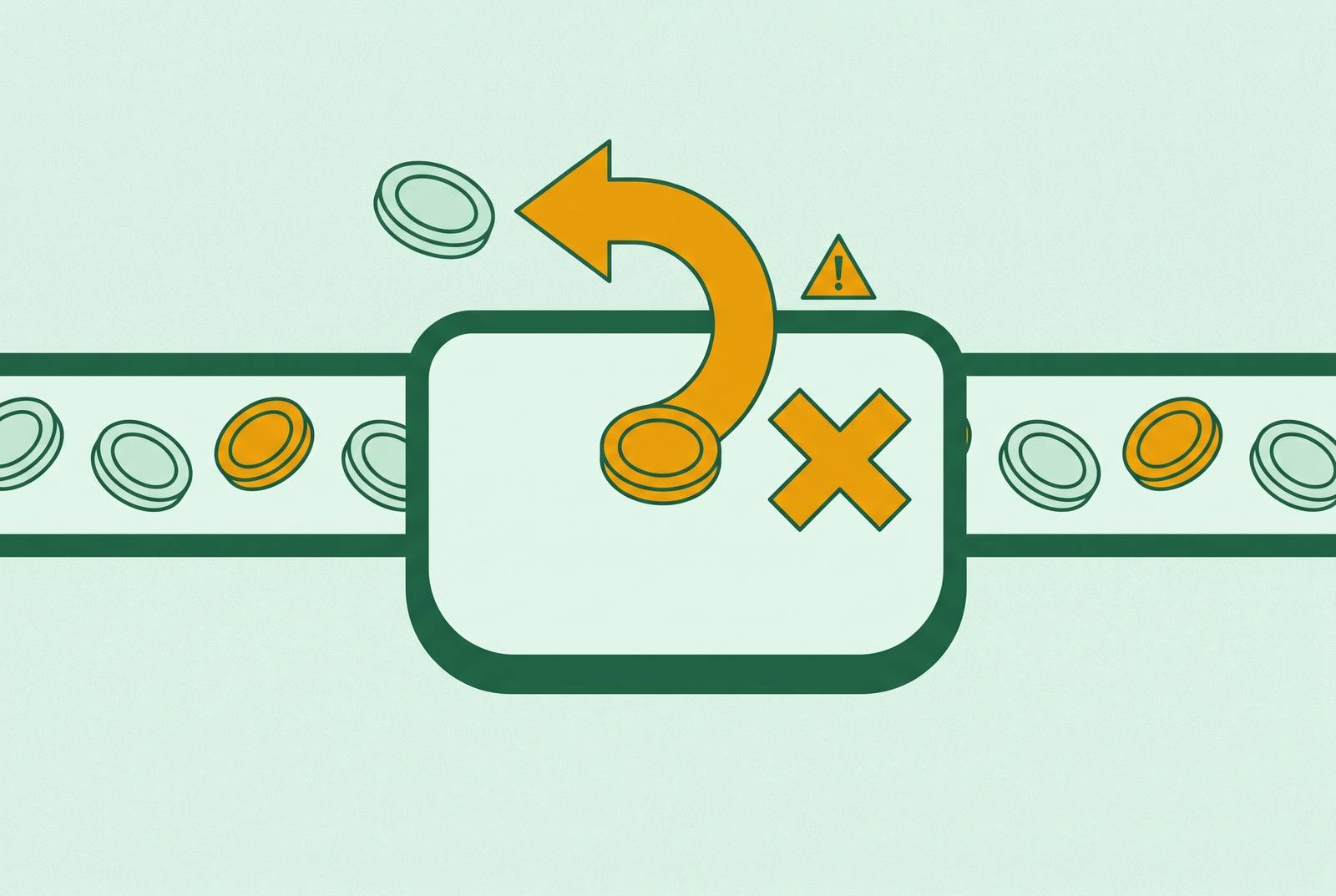
ACH returns are a feature of the system, running at scale, every single day, across the same rails that moved 35.2 billion payments and $93 trillion in value in 2025. They're a feature of it, running at scale, every single day, across the same rails that moved 35.2 billion payments and $93 trillion in value in 2025. Same Day ACH alone grew 16.7% year-over-year, hitting 1.4 billion payments. Contractor disbursements ride that infrastructure alongside payroll, insurance, and consumer bill pay, which means an operator cutting weekly payouts to a 1099 workforce is subject to the same physics as everyone else on the network: 8 to 12% of payments across industries come back as returns, as a matter of course, not exception. Run a few thousand contractor payments a week and returns are a Tuesday. They're a Tuesday.
Contractor payees complicate the math in a way vendor or consumer payments don't. Gig workers treat pay speed as a loyalty signal now, not a nice-to-have: 85% say they'd pick one platform over another based purely on how fast the money lands. A bounced disbursement doesn't just create an accounting headache. It's the reason a driver doesn't show up for the next shift, because the money he needed to put gas in the tank didn't arrive. Pay speed has quietly overtaken per-task earnings as the thing that keeps contractors loyal, which means every delay compounds against retention, not just against the ledger. And at scale, a single blunt policy, retry everything and hope, turns a routine 8-12% return rate into an operational fire that spreads across thousands of accounts before anyone notices the smoke.
How the ACH return system is structured and what the codes signal
Every ACH payment moves between two banks, full stop. The Originating Depository Financial Institution (ODFI) sends the payment; the Receiving Depository Financial Institution (RDFI) either accepts it or kicks it back. When the RDFI rejects a payment, it doesn't just say no. It attaches a return code and routes the whole thing back through the network to the ODFI, which then has to notify whoever originated the payment. That code is the entire signal an operator gets about what went wrong, and treating it as noise instead of information is where most pipeline failures start.
NACHA defines 85 of these codes, R01 through R85, and each one comes with a specific meaning, a specific timeframe, and a specific handling obligation. These are rules, and the timeframes split the codes into two operationally distinct buckets. They're rules, and the timeframes split the codes into two operationally distinct buckets.
Standard returns, things like R01, R02, R03, R04, and R09, have to come back from the RDFI within two banking days of the settlement date. Fast signal, fast decision, no excuse for sitting on it.
Authorization-dispute returns are a different animal entirely. R05, R07, R10, and R11 can take up to 60 calendar days to surface on consumer accounts. R29, the corporate equivalent, still has to come back within two banking days, oddly enough, faster than its consumer siblings. The slow ones are the dangerous ones: they can land long after the contractor relationship has ended, and by the time they arrive, they're not signaling a payment failure anymore. They're signaling a compliance event.
Notice of Change (NOC) is a wrinkle to flag. When a contractor's banking details change, the RDFI sometimes returns updated information instead of hard-rejecting the payment outright. Operators who ignore NOCs and keep resubmitting the old, stale data are manufacturing their own R02 and R03 returns. Self-inflicted wounds, entirely avoidable, and shockingly common.
The four return codes that dominate contractor payment pipelines and the different first move each requires
Four codes account for most of what shows up in a contractor payment pipeline, and each one demands a completely different first response. Treating them the same is the single most expensive mistake an operator can make.
R01, Insufficient Funds, is the most common return code in ACH generally, often making up 40 to 50% of all returns across every industry that uses the rails. In a contractor context, it usually means the disbursement schedule and the contractor's bank balance are simply out of sync, a timing problem, often temporary. NACHA permits up to two retries within 180 days of the original authorization date, but the retry should follow confirmation that funds now exist, not a countdown clock. If the same contractor keeps generating R01s, that's not a systems problem anymore. Recurring insufficient funds can mean the contractor is under enough cash-flow stress to affect whether they keep working at all. One of these four codes is also the only one where a retry is genuinely the right move, a distinction that matters enormously, because operators who apply that code's retry logic to another one of the codes are walking straight into a compliance violation.
R02, Account Closed, means the contractor switched banks and never updated their payment info, which happens constantly in gig workforces with high turnover. The rule here is not subtle: never retry an R02 against the same account. Doing so just generates a second administrative return, nudging the operator's administrative return rate closer to the 3% NACHA ceiling. The right first move is to block that account from any further submissions immediately and kick off outreach to collect updated banking details. Operators running several disbursement batches at once need to catch R02 fast, because every other pending payment queued to that same dead account is about to fail right alongside it.
R03, No Account / Unable to Locate, shows up when the account number on file doesn't match anything at the receiving bank, almost always a data entry problem: a transposed digit, a missing digit, an old record dragged forward from some prior engagement. Operators still collecting banking info through paper forms or unvalidated web fields will see R03 repeatedly, since it is a predictable defect in the intake process. It's a predictable defect in the intake process. R03 spikes especially hard during bulk onboarding, when a lot of new contractors get added at once and small data errors multiply across the batch. The fix is to collect and verify a corrected account number before resubmitting anything. Retrying on the hope that the number will somehow "resolve itself" is wishful thinking dressed up as a strategy.
R04, Invalid Account Number Structure, looks similar to R03 on the surface but means something different underneath. R03 means the number looks plausible but doesn't match a real account. R04 means the number fails basic structural validation, wrong digit count, a failed check digit, before the bank even attempts a match. This one usually traces back to a misconfigured API field mapping or a copy-paste error somewhere in the account records. No retry makes sense until someone confirms the structural problem is actually fixed and a properly formatted number is on file.
Authorization-related returns and the different category of risk they carry
R05, R07, R10, and R29 form a separate family entirely, the authorization-dispute returns. R05, R07, R10, and R11 carry a 60-calendar-day return window on consumer accounts, making them hard to manage in real time. R29, the corporate-account equivalent, runs on a shorter two-banking-day window. R05 covers unauthorized consumer debits. R07 means the customer revoked authorization. R10 means the customer says the debit was never authorized in the first place. R29 is the corporate-account version of that same claim.
Sixty days is a long time in a gig economy relationship. A contractor can pick up a shift, finish the work, get paid, and move on to a different platform entirely before a return is even processed. By the time it does, the operator has usually forgotten the transaction ever happened, but the compliance obligation attached to it hasn't gone anywhere. The clock resets nothing.
R10 and R29 look similar but apply to different account types: R10 is for consumer accounts, while R29 is the corporate-account equivalent. Contractor pipelines that pay business-entity contractors lean on CCD constantly, and mistaking an R29 for a garden-variety consumer dispute, rather than what it actually is, a corporate authorization failure, leads straight to the wrong handling every time.
The rule across this entire family is absolute: never retry a payment flagged R07, R10, or R29 without resolving the underlying authorization question first. Resubmitting a payment to an account whose holder has already said it wasn't authorized is a compliance event, the kind that can trigger a NACHA investigation on its own.
NACHA compliance thresholds and how untriaged returns push operators past them
NACHA tracks three separate thresholds, each measured its own way, and each one an operator can breach without realizing it until the notice arrives.
Administrative returns (R02, R03, R04) have to stay under 3% of ACH debit returns, calculated over the trailing 60 days. Unauthorized returns (R05, R07, R10, R29, R51) have to stay under 0.5%, same 60-day window. And the overall return rate across every reason code combined has to stay under 15%.
That 0.5% unauthorized threshold is the one that catches contractor operators off guard, because it's a small number against a large denominator. A handful of R10 or R29 returns against a high-volume disbursement schedule can blow through it fast, and unlike administrative returns, there's no data fix available. Correcting a bad account number doesn't make an authorization dispute go away.
Untriaged retries are what accelerate the breach. Retry an R02 against the same closed account and the system logs a second administrative return, not a correction. Every uninformed retry counts against the threshold, which means an operator applying blanket retry logic without matching the response to the code can double or triple their administrative return count inside a single 60-day window, entirely by accident. NACHA's enforcement isn't theoretical: rule noncompliance can escalate to fines up to $500,000, suspension from originating ACH entries altogether, and lasting damage to the relationship with banking partners who don't love being associated with an account under investigation.
Building a code-to-action triage map for contractor disbursements
The fix is simple to state and hard to skip: every return code should map to a defined action, decided in advance, not litigated case by case by whoever happens to be on shift that day. Consistency, not judgment calls, is what keeps return rates inside NACHA's thresholds once volume climbs into the thousands.
Three categories cover the whole space. Retry eligible, with conditions: R01 and R09, where a retry is fine only after confirming funds or availability, respecting the two-retry cap and the 180-day window, and logging each attempt against the original authorization. Hard stop, update and resubmit: R02, R03, and R04, where the account gets blocked immediately, outreach goes out to the contractor for corrected banking details, and resubmission only happens once verified data is actually in hand. Hard stop, compliance review before anything else: R05, R07, R10, and R29, where every scheduled payment to that account freezes, authorization records get preserved, and the whole thing routes to compliance review with no resubmission until resolved.
Storing structured attributes for each code inside internal tooling, the code itself, its category, whether retry is even permitted, the max retry count, whether contractor contact is required, whether a compliance flag fires, turns this from a judgment call into something a system can route automatically. At the scale a contractor pipeline actually runs, that automation isn't a convenience. A back-office team reading return codes one by one and deciding what to do with each one simply cannot keep pace with thousands of weekly disbursements. The decision logic has to live inside the payment workflow itself.
Preventing the returns that triage cannot fix: onboarding and verification as the upstream defense
Administrative returns, R02, R03, R04, are the one category that's genuinely preventable before a payment ever gets sent, because they're downstream of bad account data, and bad account data enters the pipeline at onboarding, not at disbursement.
Operators still collecting banking details through paper forms or basic unvalidated web fields are going to see R03 on a loop, a process gap with a name and a fix. That's a process gap with a name and a fix. It's a process gap with a name and a fix.
Account verification before the first disbursement closes most of that gap. Confirm that the account actually exists and is open, and R02 never gets a chance to fire. Validate the routing number against a current list of financial institutions, and R13 gets caught before submission. Validate the structure and format of the account number itself, and R04 never leaves the building. Confirm the account is actually owned by the contractor on record, and the exposure to R10 and R29 drops, because the money is going to the party who's actually authorized to receive it.
Bulk onboarding deserves particular attention, because it's the moment where a single misconfigured import field turns into returns across an entire cohort at once. Adding a hundred contractors at a time multiplies whatever small data error is hiding in the intake process, and by the time the returns start showing up, the damage is already baked into the batch. Catching it before the import runs, rather than after, keeps an onboarding cycle clean instead of triggering a week spent chasing down bounced payments one contractor at a time.