Building a Live Compliance Signal Stack for Multi-State Independent Contractor Networks
Real-time monitoring across state lines catches compliance drift before audits do.
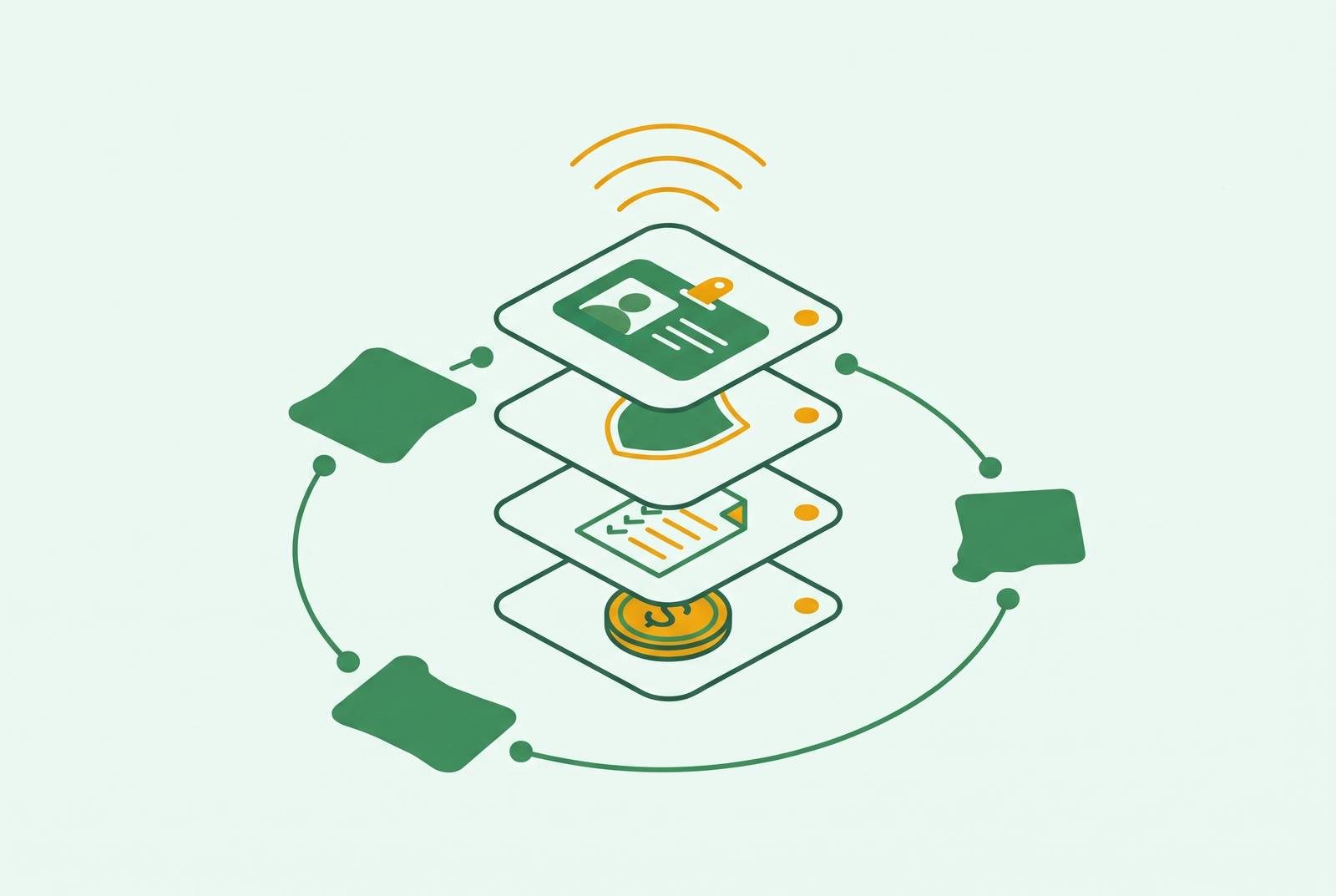
Real-time IC compliance monitoring for delivery operators that work across states needs four linked data layers for jurisdictional rules, classification posture, credentials, and insurance coverage. Each layer must refresh as conditions change and route alerts to someone authorized to act. Building this live compliance signal stack replaces the blind interval between quarterly audits with continuous monitoring of where contractors work and how their relationships operate.
Why periodic audits fail multi-state IC networks in 2026
An operator finishing a quarterly compliance audit in October may be working from rules that changed in September. The paperwork can be complete while the assessment is already stale. Timing is the structural defect. An audit discovers what happened between reviews, including relationships that drifted out of compliance while dispatch continued. By then, liability may already have accrued.
The Department of Labor’s 2024 economic reality rule illustrates the difficulty in 2026. As of October 2026, it remains in the Code of Federal Regulations, although the agency stopped applying it in May 2025 and proposed replacing it in February 2026. No final replacement has been published. Operators therefore face a distinction between the regulation on the books and the agency’s enforcement approach that a scheduled review can miss. Because a misclassification finding usually applies to workers doing similar work under the same arrangement, finding it late can put a whole fleet segment at risk along with the contractor.
What a compliance signal stack is and why the architecture metaphor fits
Each layer tracks a different dimension of compliance and feeds alerts when its state changes. A single human-updated “compliant” field compresses several independent conditions into one answer, hiding both the source of a problem and when it began. A green box is not an architecture.
The architecture metaphor fits because the layers have separate jobs but depend on shared inputs and defined connections. Work location is one such input. Classification follows where the contractor performs the work. A contractor working in New Jersey is subject to that state’s ABC test even if the company has no other presence there. The stack therefore needs the contractor’s current state of performance throughout the engagement.
Layer one: the jurisdictional rule-change feed
New Jersey’s Department of Labor issued an independent contractor regulation that takes effect on October 1, 2026. Its reach includes nationwide operators engaging workers who perform services from home offices or other locations in New Jersey. A rule feed scoped only to the company’s offices would miss the workers whose location makes the regulation relevant.
Kansas passed a portable benefits law for gig workers in 2026, and Washington gave its state labor board new powers. Minnesota tightened construction contractor rules in its 2024 session. These actions concern different activities and obligations, so a feed must identify relevance as well as change.
In practice, the layer combines legislative tracking services scoped to the active contractor footprint with an inventory of each state’s governing test, including ABC, economic reality, and common-law tests. Alerts should make clear which changes are proposed and which have been enacted. Federal monitoring runs in parallel because finalization of the proposed replacement for the 2024 rule would change the federal framework beneath the state analysis.
Layer two: the classification posture monitor
A rule-change alert becomes actionable only when the operator knows how affected relationships actually function. This is the operational reality layer. A contract may describe independent work while the way dispatch works slowly leads to exclusivity, detailed instructions, or an open-ended relationship with no limits tied to a project. The monitor detects those changes so they trigger a review.
The IRS common-law factors organize signals into behavioral control, financial control, and relationship type. Relevant inputs include schedules, instructions, training, investment, profit-and-loss opportunity, multiple clients, contracts, benefits, and permanence. The DOL economic reality framework examines control, profit or loss, permanence, investment, whether work is integral to the business, and skill and initiative. These frameworks overlap, but they are not interchangeable.
State tests add another decision boundary. California and Massachusetts presume employment unless all three ABC conditions are met, so the monitor must apply the strictest applicable test for the contractor’s work location. A review should start when a contractor takes dispatches only from one client or gets instructions on how to do the work. These signals point to risks that need review before a legal verdict can be reached.
Layer three: the credential and document currency tracker
A contractor’s personal auto policy excludes commercial use, the commercial coverage certificate on file expired last month, and a claim happens today. Yesterday’s complete onboarding file offers little comfort. The tracker exists to prevent that gap from remaining invisible while the contractor continues making deliveries. A personal policy with a business-use exclusion will not pay the commercial-use claim simply because a certificate once occupied the correct folder.
Different documents need different clocks. A background check ages differently from an insurance certificate, while a commercial driver’s license endorsement has its own expiration horizon. The tracker must keep dates for each document and send alerts with enough time to renew it before it expires. It must also monitor active contractors for changes such as a disqualifying motor vehicle record event.
Those requirements must follow the work location. A contractor who moves dispatch work into another state may need different licenses even though the person and vehicle are the same. Linking the credential tracker to the jurisdictional layer makes that move a review trigger.
Layer four: the insurance coverage integrity layer
Hired and non-owned auto liability, or HNOA, covers a gap that is often missed when a contractor uses a personal vehicle under dispatch. It is secondary coverage for the operator’s liability, stepping in when the underlying policy is exhausted or denies a business-use claim. It does not replace the contractor’s required coverage.
The operator’s coverage needs are broader still. Commercial auto liability covers vehicles that are owned or run under the operator’s authority, while cargo insurance covers freight as it travels. Occupational Accident Insurance, or OAI, gives medical and disability benefits to contractors who are injured. These coverages perform different jobs, so a current policy in one category cannot stand in for a missing policy in another.
Contingent liability coverage addresses the classification bridge. Great American Insurance Group describes its product as providing defense when a qualified independent contractor seeks workers’ compensation benefits as an employee, with equivalent benefits available only if the driver is deemed an employee. The integrity layer must therefore monitor operator policy renewals as well as contractor certificate expirations. Either side can create a gap.
How the layers interlock: the cascading alert logic that makes the stack live
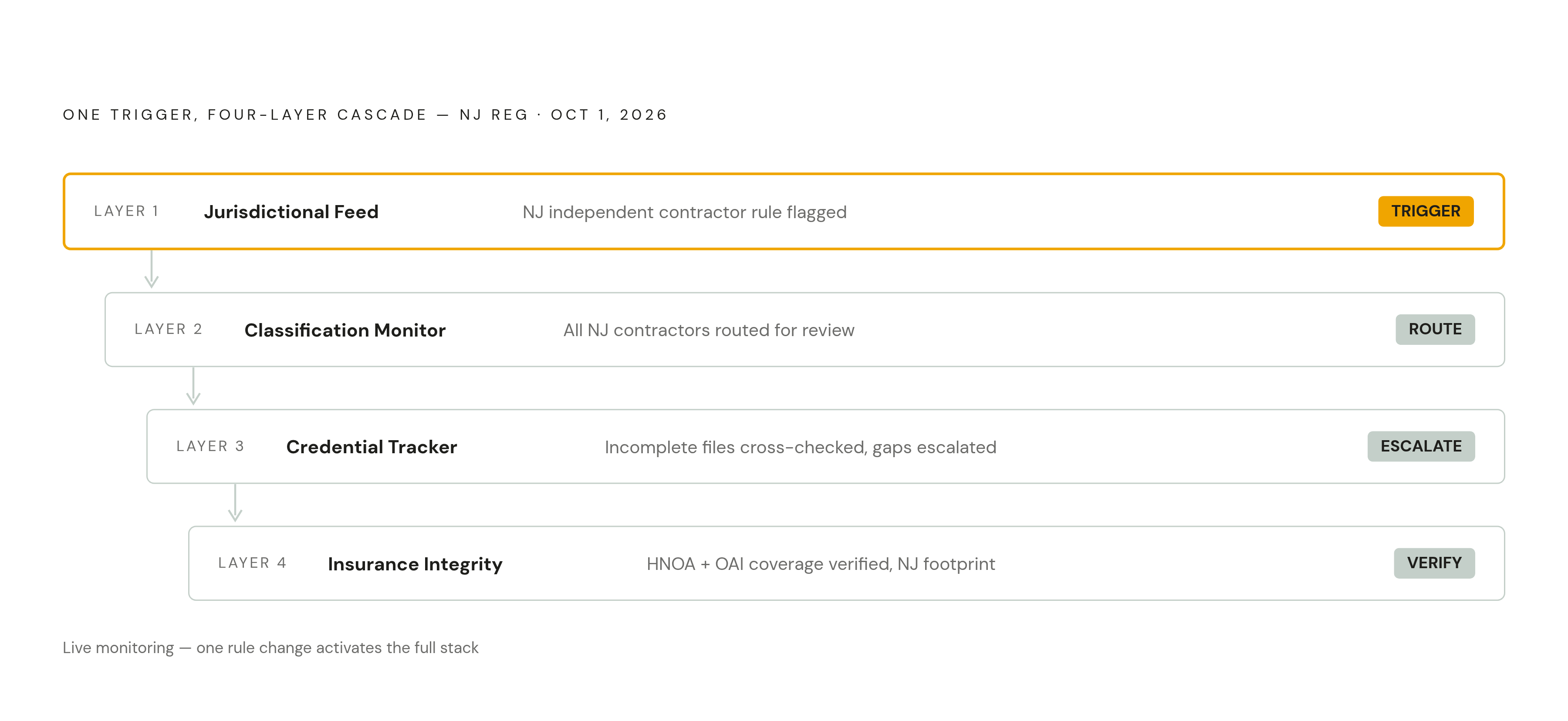
The New Jersey change provides a worked example of an alert cascade. Layer one flags the regulation effective October 1, 2026, and layer two routes every contractor working in New Jersey for classification posture review. Layer three then cross-checks those contractors for incomplete credential files and escalates gaps. Layer four checks that HNOA and OAI coverage is current for the New Jersey footprint. One change now produces a connected response.
The cascade can also begin with a document. When a contractor’s vehicle insurance certificate expires, the credential layer should start a coverage review and automatically stop dispatch until the certificate is renewed. HNOA may provide a bridge for the operator’s liability, but it is not permission to ignore the expired certificate.
Portable benefits make the same distinction important. State safe harbors protect only against state-level reclassification findings, leaving the FLSA economic reality test and IRS common-law factors unaffected. To support these cross-layer decisions, the architecture needs one source of truth for each contractor, configurable alert thresholds, and an escalation path to someone authorized to act.
Onboarding as the stack’s entry gate, not a separate process
Every downstream alert depends on the quality of the contractor’s initial record. Onboarding populates work location, classification signals, credentials, and coverage elections. A missing input can produce a false negative. The system may appear quiet because it lacks the information needed to detect a problem.
Serial credentialing creates an indeterminate entry window in which work may begin before the record is complete. The credential layer can recognize training only if there is a machine-readable record that it is complete. Capturing a home address without the state of active performance deprives the jurisdictional layer of its essential input.
The recommended design captures all four layers in parallel. A dispatch or HR trigger starts entry into the contractor management platform, credentialing services return status automatically, and insurance enrollment is recorded at completion. Dispatch communication channels activate only after all four layers are green. For a network that keeps replacing contractors who leave, this gate gets heavy use, and the quality of its data affects the whole stack.
Pay speed as a retention signal inside the compliance stack
Contractor churn amplifies compliance workload because every replacement creates another onboarding event. That is when the record is least complete. Faster payment can reduce churn and therefore reduce traffic through the stack’s most vulnerable point.
Same-day ACH settles batches faster but still has a window in which payments can be returned. RTP and FedNow provide real-time, final bank-account settlement, while push-to-card options such as Visa Direct and Mastercard Send offer near-instant fund availability. Those distinctions prevent “instant” from becoming a word doing more work than the payment network.
Payment structure also feeds classification analysis. Output-based rather than hourly compensation, profit-and-loss variability, and the ability to work for multiple clients are relevant to financial control and economic reality. A payment system that records these details keeps supplying data for classification. Fast pay can support retention, but it does not establish independence by itself.
Scaling the stack: what changes when the contractor network grows from dozens to thousands
Adding a state is not simply adding contractors. It adds a set of rules to follow, licensing requirements, and another jurisdiction whose changes must be linked to the right records. A back-office team that can manually follow dozens of relationships cannot follow thousands without a proportional increase in staffing.
Credential expiration, classification drift, coverage gaps, and relevant rule changes must trigger reviews without someone inspecting every contractor individually. Automation handles monitoring, while human attention goes to the alert and the decision it requires.
Buying occupational accident and commercial auto coverage in bulk can cost less per contractor than having each contractor buy it. For operators weighing a build against a platform, the comparison is therefore broader than document storage. It includes legislative monitoring, classification signals, credential tracking, insurance connections, and the ongoing work of updating those systems as state laws change.
Standing up the stack: a sequenced implementation path for IC-network operators
For operators beginning implementation, the sequence should follow data dependencies. First, map every state where active contractors do their work. Headquarters and residential addresses are not substitutes. Second, establish classification posture under the applicable tests, reviewing relationships before engagements begin and whenever the work changes. That baseline gives later drift alerts a starting point to compare against.
Third, list each active contractor’s required documents, their current status, and when they expire. A gap found here is present exposure. Fourth, audit the operator’s commercial auto, HNOA, cargo, and OAI coverage, establishing that HNOA is in place. The OAI review should cover all active contractors.
Fifth, configure expiration lead times, jurisdictional triggers, and escalation ownership so alerts reach someone empowered to act within the same business day. Sixth, close the onboarding gate by gathering data for all four layers in parallel before turning on dispatch. Nine states introduced portable benefits bills in the first month of the 2026 legislative session alone, making jurisdictional monitoring a live subscription. Compliance is not a state the operator reaches, but a signal the operator maintains.