Occupational Accident Insurance vs. Workers Compensation for 1099 Drivers
Independent contractors need occupational accident insurance, not workers' compensation.

Every night, thousands of drivers pull out of warehouse lots with a trunk full of packages and a 1099 in their onboarding file, and most of them have no idea whether a sprained wrist on a loading dock is covered by anyone. That gap drives the entire insurance conversation for delivery networks, because classification determines which products are even available, and you cannot solve it by comparing two quotes. It starts with a legal question: is this worker an employee or an independent contractor? The answer, set by statute and by the actual facts of the working relationship, determines which insurance products are even available to buy. Workers' compensation is built for W-2 employees and state-mandated on that basis, not offered as a menu option insurers extend to contractors out of preference. A driver counts as an independent contractor only if applicable law and the day-to-day work say so, not because a tax form in a filing cabinet says so, and enforcement agencies and courts scrutinize that distinction closely. The practical consequence is blunt: most contract drivers working without employer-purchased occupational accident insurance (OAI) have no work-injury coverage of any kind, and an operator skipping that purchase to save a line item is not cutting cost, it is stacking up risk that has not been priced yet. Some platforms try to solve this by extending workers' comp to 1099 drivers anyway, which does not fix the coverage gap so much as hand a misclassification lawsuit its first exhibit, because buying workers' comp for a contractor looks a great deal like treating that contractor as an employee. A platform reaching for workers' comp to protect its drivers can end up manufacturing the exact liability it was trying to avoid.
Workers' compensation covers and its design gap for contractors
Workers' compensation is a state-regulated system, and its benefits, funding, and enforcement mechanics are all written into statute rather than negotiated in a private contract, which makes it a far more rigid instrument than anything an operator would choose off a shelf. Where it applies, it covers a wide range of outcomes: medical treatment with no dollar ceiling, wage replacement set at a percentage of prior earnings, permanent disability payments for workers who cannot return to full duty, death benefits for dependents, and in some states vocational rehabilitation. That breadth is the point. Workers' comp was built as a complete substitute for litigation, and the feature that makes it complete is the exclusive-remedy doctrine: once it applies, an injured employee generally cannot sue the employer over that same workplace injury. The employer trades guaranteed coverage for legal protection, and that bargain works cleanly for a W-2 workforce, but it disappears if an operator tries to apply OAI in its place, a trade-off this piece covers in full later. If the law mandates workers' comp and an operator skips it, the penalties can get severe enough to make the premium look like a bargain in hindsight, so you cannot just decide the cost isn't worth it. The assumption that workers' comp stops at the W-2 line is also getting less stable by the year: some state legislatures are already moving to mandate coverage for gig workers regardless of how those workers are classified under other statutes, so treating "contractors are exempt" as a permanent rule rather than a current one is a bet an operator makes at its own risk.
What occupational accident insurance covers
Occupational accident insurance is a privately structured, optional product built specifically for independent contractors, the population that falls outside workers' comp eligibility rules. A standard OAI policy pays accident medical expenses (hospital, surgery, treatment, rehabilitation), disability income replacement for a defined period at a percentage of prior weekly earnings, and accidental death and dismemberment benefits paid as a lump sum to beneficiaries or to the injured worker. Some policies also add paralysis benefits or physician referral services on top of that base. Coverage runs on a no-fault basis. A driver does not have to prove the platform did something wrong to get paid. It means the policy pays out based on whether the injury happened during covered occupational duties, full stop, whether that's a jackknife on a patch of ice, a slip crossing a warehouse catwalk, or a strained back while securing a load. No-fault status says nothing about whether the operator can still be sued over the same incident, a distinction that becomes important two sections from now. The structural difference that separates OAI from workers' comp most sharply is the cap: OAI medical benefits stop at the policy limit the operator selects, not at an open-ended ceiling set by statute. Look at California's Prop 22 to see what a state-set floor looks like for this kind of coverage: it requires medical expense coverage of at least $1 million and disability payments at 66% of a driver's average weekly earnings for up to 104 weeks. Setting the limit is the operator's job. The cost savings and the responsibility for adequacy both land on the same desk. That savings is real and measurable: OAI generally runs about 30% less than workers' compensation, a gap that comes from defined limits and from pricing a population the workers' comp rating system was never built to rate. Some insurers also offer a pay-as-you-go structure that ties premium to active dispatch periods rather than total contractor headcount, so a platform pays for coverage while a driver is actually working a route, not for every hour that driver is technically available but logged off.
How operators close the real gaps in OAI coverage
OAI is the right structural fit for a 1099 delivery network, and that fact does not make it a complete answer by itself. Operators who stop at "we bought OAI" and move on are often trading one exposure for another they haven't measured yet. The first gap is the missing exclusive-remedy shield. A contractor covered by OAI can still sue the platform over the same injury the policy just paid out on, in some circumstances, because OAI buys cost control and flexibility but not the legal protection bundled into workers' comp. A contingent liability policy layered alongside OAI is built for that specific gap, and it protects the operator when an injured contractor turns around and argues they were actually a W-2 employee entitled to full workers' comp benefits. So OAI and contingent liability coverage together function as a second line of defense against exactly the kind of costly lawsuit that OAI alone leaves open. The second gap is benefit caps on catastrophic injuries. A bare-bones plan with a low medical limit will not come close to covering a serious spinal injury or a long ICU stay, so an operator setting limits purely to minimize premium is buying a policy that looks adequate until the one claim arrives that it can't absorb. The third gap is disability income duration: OAI caps payments at a defined window, 104 weeks under the Prop 22 benchmark, while workers' comp can pay a permanently disabled worker for life. A driver who exhausts that 104-week window is left with Social Security Disability or personal savings, and operators deploying OAI owe their contractor workforce clear communication about where that cutoff sits, so nobody discovers it for the first time mid-claim. The fourth gap is third-party liability, and you won't find it touched by OAI or by workers' comp. If an accident injures a pedestrian or another driver, you have to look past both of these products to a commercial auto liability policy. The full insurance stack for a last-mile operator layers commercial auto liability, cargo insurance, general liability, and OAI together, and none of the four does the job of the others.
How misclassification risk intersects with the OAI decision
No policy, not OAI, not workers' comp, not contingent liability, fixes a classification mistake after the fact. Classification determines which coverage is even legally available to an operator in the first place, and getting it wrong creates exposure no policy limit can absorb. The regulatory ground here keeps moving. In early 2026 a federal labor regulator proposed a new rule to reshape how independent contractor status gets evaluated, and the comment period closed April 28, 2026, but the proposal still was not finalized as of that date. If operators build a compliance posture around any single version of the federal standard, they are building on ground that could shift under them. The cost of getting this wrong is not theoretical. Lyft paid the state of New Jersey a significant sum in September 2025 to resolve misclassification challenges tied to employee benefits, and in California, the per-worker penalty alone can reach substantial amounts for each worker found to be misclassified. The trap that matters most in the OAI context is specific: a driver hurt on the job can later claim they were a de facto employee entitled to full workers' comp benefits despite having signed on as a contractor. That lawsuit looks like an insurance claim, but it is a classification dispute, so OAI cannot defend against it alone. GigSafe, among other platforms automating compliance workflows across 1099 contractor networks, documents and maintains the working relationship correctly from day one, and it treats classification as the foundation that every downstream insurance decision rests on, not an afterthought to clean up later. Classification has to be made on the actual merits of the working relationship, documented in detail, and revisited as the regulatory landscape shifts. Treating it as a box checked once at onboarding, rather than a posture maintained continuously, is where most of this exposure originates.
Side-by-side comparison of OAI and workers' compensation across the factors that matter to delivery operators
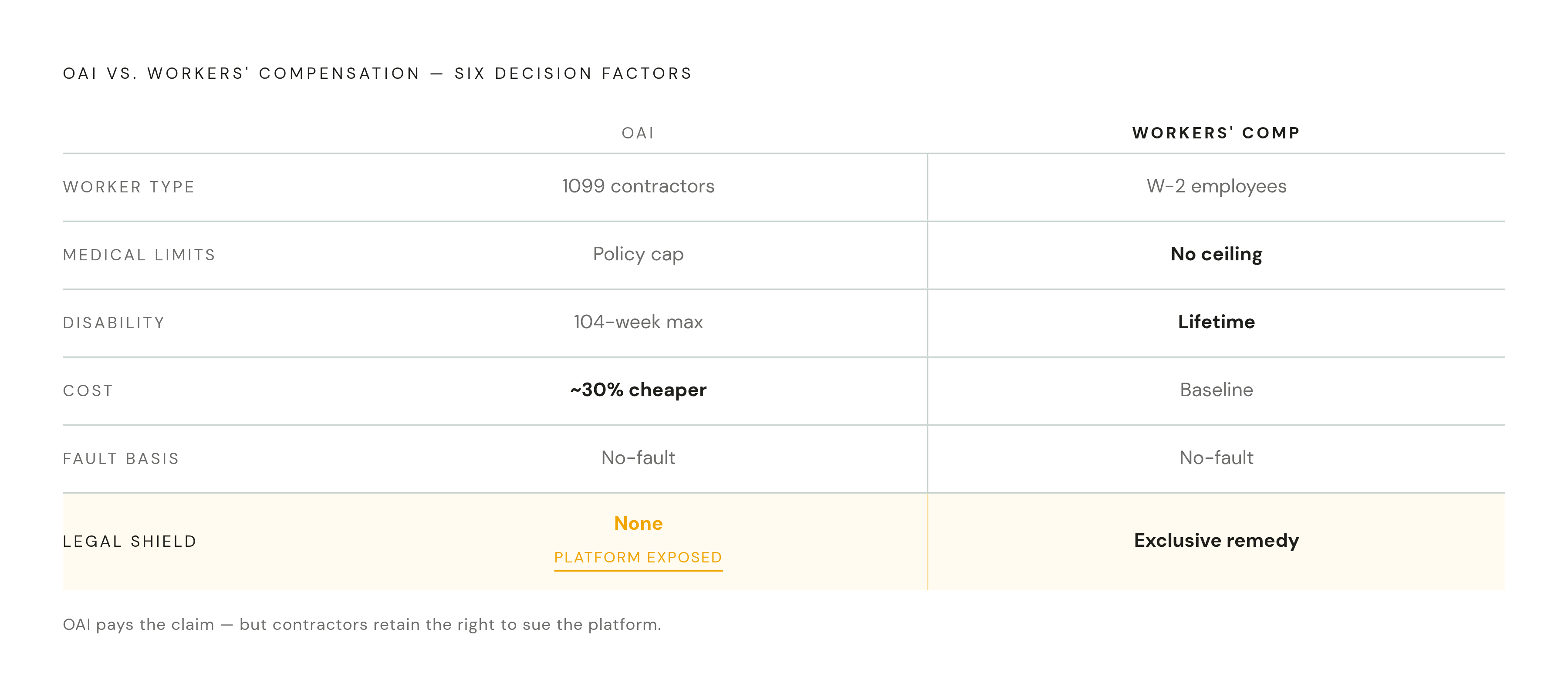
Measured against the factors that actually drive an operator's decision, cost, coverage structure, legal fit, flexibility, and misclassification risk, OAI comes out as the correct structural choice for a properly classified 1099 delivery network, while workers' comp is both a poor fit and a potential source of liability in that same context. OAI is built for 1099 independent contractors, and workers' comp is built for W-2 employees, but state laws can carve out exceptions, so you need to check your own state's rules alongside whatever your lease agreements require. On legal requirement, OAI is not mandated federally, though many carriers require it as a condition of lease agreements, while workers' comp is state-mandated for employers of W-2 workers in most states. On medical limits, OAI caps benefits at whatever policy limit the operator selects, while workers' comp generally pays medical claims with no ceiling. OAI typically pays a percentage of prior weekly earnings for a fixed window, but workers' comp pays a state-regulated percentage that can extend to lifetime payments if the disability is permanent. On cost, OAI generally runs about 30% cheaper than workers' compensation, whose premiums are set by state rate schedules and calculated against payroll. On fault, both products operate on a no-fault basis within the scope of what each one covers. And on legal shield, workers' comp generally protects the employer from personal injury lawsuits brought by covered employees under the exclusive-remedy doctrine, but OAI carries no such shield, so contractors can still sue the platform in some circumstances regardless of what the policy paid out.
OAI limits are set by the operator rather than fixed by statute, so if you run a large contractor network, you need a way to track which drivers are actually covered, at what limits, and whether that coverage still matches the work those drivers are doing. That is a compliance detail that end-to-end contractor management platforms, including GigSafe, are built to monitor on an ongoing basis. The underlying comparison does not change: OAI fits the structure of a 1099 workforce, workers' comp fits the structure of a W-2 one, and the gap between them closes only through deliberate layering of coverage and documentation, not through picking the cheaper label on a quote sheet.
Sources
- Occupational Accident vs. Workers' Compensation
- Occupational Accident Vs. Workers' Compensation Insurance: A Comprehensive Guide
- What if workers’ compensation coverage is required for app-based drivers in California?
- No Free Delivery Misclassification Comes at a Price: Keating Muething & Klekamp PLL
- Workers’ Compensation: Overview and Issues
- Occupational Accident Insurance - Insurance Incorporated
- Workforce Reclassified: Understanding DOL’s “New” Independent Contractor Classification Rule
- Spotlight On: Workers Compensation - Triple-I®