Onboarding Module Sequencing for 1099 Delivery Contractors
Prioritize legal protections before contractor deployment to avoid misclassification exposure.
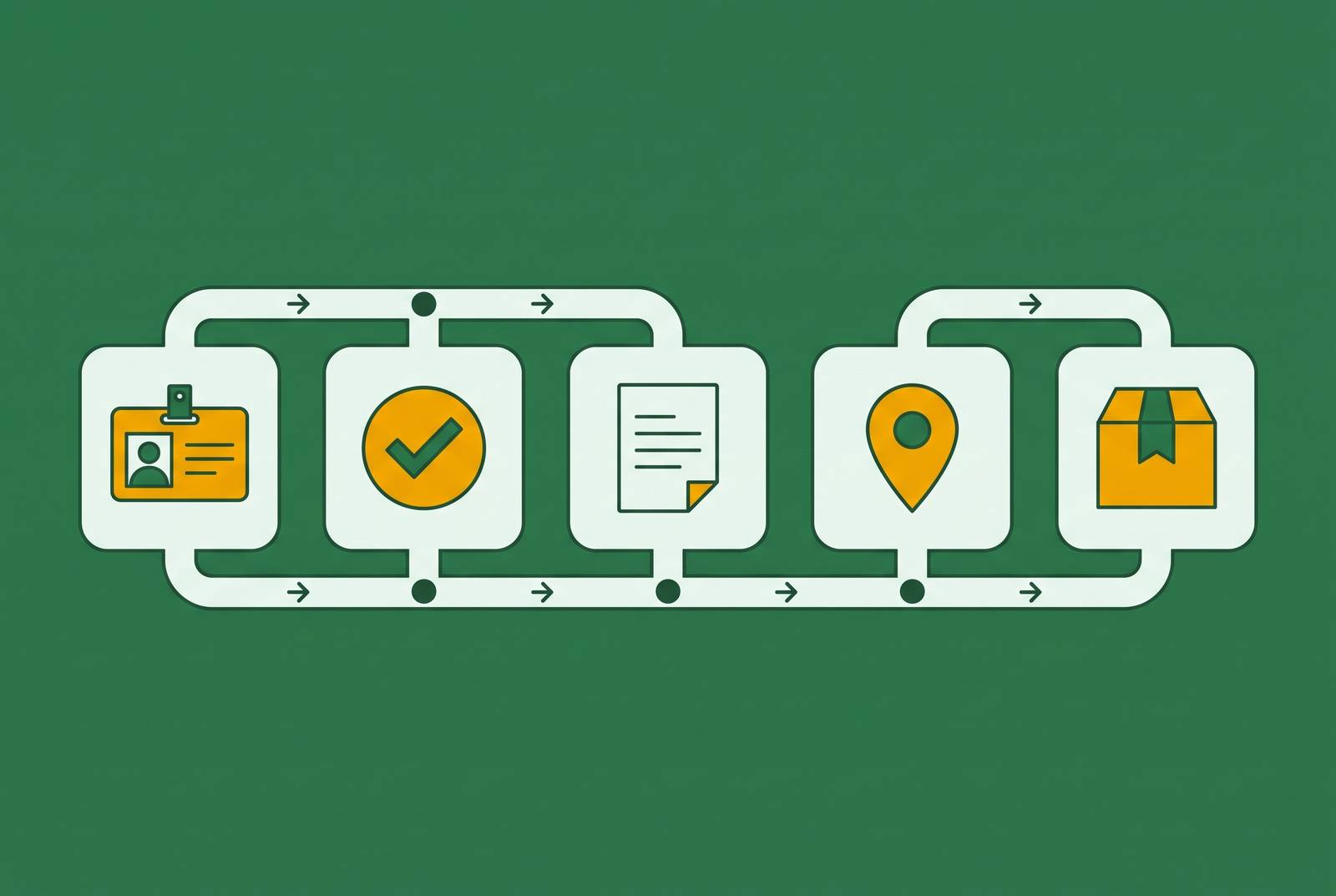
Last-mile delivery runs on 1099 contractors now, and the order in which those contractors move through onboarding decides whether a company is protected or exposed before the first package ever leaves the warehouse. Front-load the steps that carry legal weight, defer the ones that don't, and time-to-deployment stays fast without leaving gaps an auditor can drive a truck through. Get the sequence backwards, and speed becomes the thing that gets a company sued.
The last-mile delivery boom as a strategic bottleneck for contractor onboarding
The last-mile delivery market is set to roughly double, from $183.85 billion in 2026 to $364.60 billion by 2034, growing at 8.9% a year. North America leads that growth at 9.7% annually. Volume is already enormous: US parcel shipments hit 22.37 billion in 2024, and revenue growth hasn't kept pace with volume growth. The economics of moving a box from warehouse to doorstep keep getting tighter even as the number of boxes climbs.
None of that volume moves without independent contractors. Walmart's Spark Driver platform now reaches more than 85% of US households, and roughly three-quarters of Walmart's delivery orders get fulfilled by ICs, not employees. Contractors are the delivery network. They're the delivery network.
That network is getting more expensive to run on both ends. Seventy-six percent of retailers say last-mile costs have gone up, and delivery costs rose an average of 12% from 2024 to 2025. Operators are squeezed by rising costs and thin margins at the same time. Every inefficiency in how a contractor gets activated, whether that's a slow background check or a missing insurance certificate, costs real money and creates real legal exposure. Onboarding is the choke point the entire operation runs through. It's the choke point the entire operation runs through.
Misclassification risk for a delivery company in 2026
The regulatory picture in 2026 is messier than the headlines suggest, and messier is the accurate word for it. On February 26, 2026, a federal labor agency proposed rescinding the 2024 independent contractor rule and going back to a two-factor economic reality test: how much control the company exercises, and whether the worker has a genuine opportunity for profit or loss. DOL had already told investigators back in May 2025 to stop applying the 2024 rule.
That sounds like relief for delivery operators. It isn't the whole story. The 2024 rule still governs private lawsuits brought under a federal wage-and-hour statute, even while enforcement by the agency sits paused, so a worker's attorney can still build a case on the old, stricter standard. State tests are untouched by any of this federal maneuvering. California's ABC test, along with similar frameworks in Massachusetts and New Jersey, keeps operating exactly as it did before DOL changed its posture. A federal rule going soft is not a green light to relax classification practices; it's a narrowing of one front in a fight still being waged on several others.
State legislatures aren't sitting still either. California's AB 1514, effective January 1, 2026, extends contractor exemptions for licensed manicurists and commercial fishers, carving out specific industries rather than loosening the rules broadly. State-level risk stays active, sometimes gets more granular, even as federal enforcement eases up. A delivery company treating 2026 as an all-clear signal is reading one page of a much longer document.
How onboarding builds or breaks the classification firewall
Compliance in this context is about building a layered system, contractual terms, operational practices, insurance coverage, that together signal to any regulator or plaintiff's attorney that the relationship is genuinely independent. It's about building a layered system, contractual terms, operational practices, insurance coverage, that together signal to any regulator or plaintiff's attorney that the relationship is genuinely independent. Call it a firewall, because that's functionally what it is: a set of controls designed to contain risk before it spreads.
Regulators don't show up and take a snapshot. Regulators and auditors piece together a working relationship from documents, from patterns of behavior, from whatever paper trail exists. Most of that trail gets created during onboarding, whether anyone plans for it or not.
Three categories of evidence get scrutinized, and all three trace back to how onboarding was built. Behavioral control asks whether the company dictated how the work got done, which shows up in whether training modules teach the platform's mechanics or mandate specific operational scripts. Financial control asks whether the contractor has a real shot at profit or loss, meaning their own vehicle, their own insurance, the freedom to drive for competitors. Type of relationship asks for the paperwork itself: a signed IC agreement that reflects actual independence, a completed W-9, certificates of insurance on file.
Every one of those signals gets captured during onboarding, or it never gets captured. A contractor who's already making deliveries without a signed agreement, verified insurance, and a completed W-9 is a contractor whose independence exists nowhere on paper, a substantive gap rather than a technicality. That's the entire case, missing.
Module sequencing: compliance-critical steps versus deployment-enabling steps versus lower-stakes training
Not every onboarding step carries the same weight, and treating them as if they do is where operators lose money in one of two directions. Front-load the steps that create legal exposure the moment they're skipped. Push the steps that only affect performance to later, once the contractor is already protected and already working.
Compliance-critical steps, deployment-enabling steps, and lower-stakes training are three categories. Compliance-critical steps have to happen before a contractor makes a single delivery: the IC agreement, the W-9, insurance verification, the background check, license verification. Skip any of these and the company is exposed from minute one. Deployment-enabling steps have to be done before a contractor can function on the platform at all, things like app access, route eligibility, payment setup, but their absence doesn't create legal risk on its own, just an idle contractor. Lower-stakes training, platform tutorials, supplemental safety content, shipper-specific orientation, can run after first deployment or alongside it without creating exposure if it slips by a day or two.
Getting this backwards costs money in one of two ways. Treat everything as equally urgent, and onboarding crawls. Rush past the compliance steps to get contractors moving faster, and the company is sending uninsured, unverified drivers onto the road to save a few hours. Neither trade is worth making.
Identity verification sits underneath all three categories rather than inside any of them. The person completing the onboarding modules has to be confirmed as the person who will actually be doing the driving. That's a gate everything else passes through, not a step on a list.
The recommended sequence: how to order modules from contract signing through post-deployment training
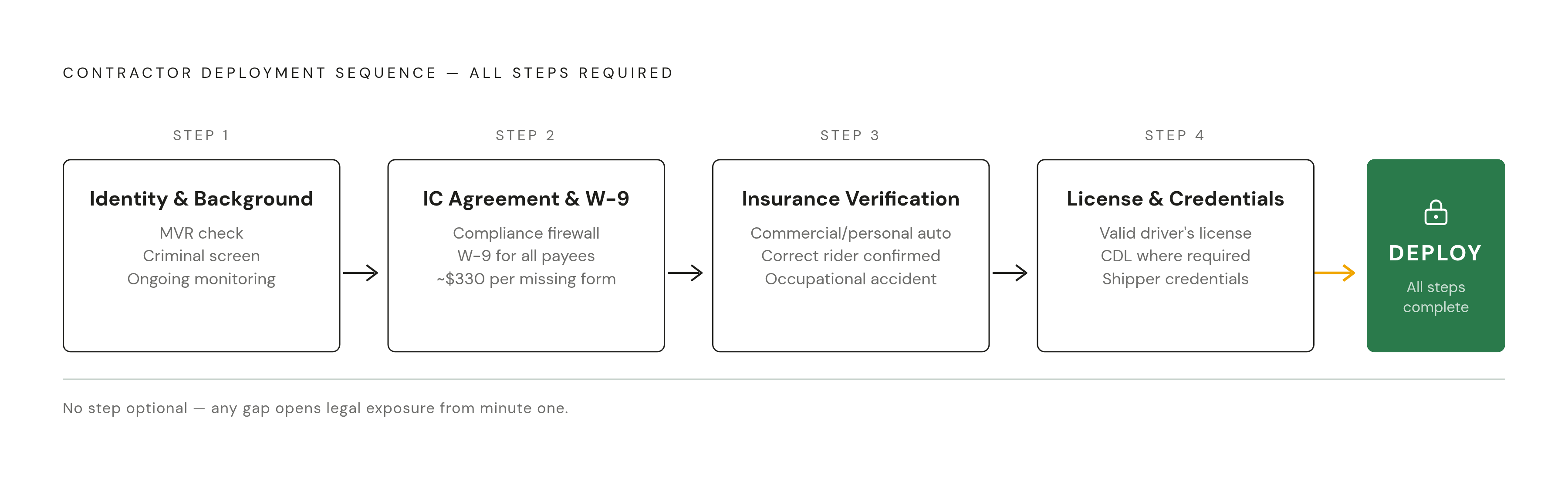
Step 1 is identity verification and background screening, and it sits before the sequence even starts rather than as item one on a list. The person filling out the paperwork needs to be confirmed as the same person who shows up to drive. That means a motor vehicle record check and a criminal background check, both reviewed before the IC agreement even gets presented. With contractors cycling across multiple platforms at a fast clip, this can't be a one-and-done check. An ongoing monitoring cadence needs to get set up right here, at the start.
Step 2 is the IC agreement and W-9, and it's non-negotiable as the first real module. The signed agreement is the foundation the entire compliance firewall rests on, and it has to exist before anything else about the relationship gets built. It needs to reflect genuine independence: the contractor controls how and when the work gets done, and carries real opportunity for profit or loss. Collecting the W-9 at this stage locks in taxpayer ID before any money changes hands, which avoids backup withholding headaches down the line. For 2026, the 1099-NEC reporting threshold rises to $2,000 for payments made this year, but that doesn't make W-9 collection optional below the threshold. All income is still taxable, and audit readiness means having documentation for every payee, not just the ones who cross a dollar line. Failing to file a required 1099 runs a penalty of roughly $330 a form. Multiply that across a contractor network with systemic gaps, and it stops being a rounding error.
Step 3 is insurance verification, and it sits third for a reason. Commercial or personal auto coverage with the right rider needs a verified certificate before a contractor gets assigned any delivery. Occupational accident coverage needs confirming too, because if a contractor later gets reclassified as an employee, an Occ/Acc plan that doesn't meet workers' comp standards leaves the company holding the bag after an injury. Putting this at step three instead of step seven is deliberate: an uninsured contractor creates liability the second they pull out of the parking lot, and no amount of training after the fact undoes that. Operators who buy occupational accident and commercial auto coverage in bulk through a centralized platform tend to bring per-contractor costs down while keeping coverage consistent across the whole fleet.
Step 4 is license and credential verification. Valid driver's license confirmed, CDL verified where the route calls for it, and any shipper-specific credentialing requirements checked off, since some shippers won't accept a load without documented compliance already in place. This comes after insurance, not before, because a contractor with a spotless license and no insurance is still a liability sitting in a truck. Both need to be settled before deployment, full stop.
Preventing onboarding sequence breakdowns in practice
Speed pressure is the most common failure, and it's the most predictable one. Capacity shortfalls push operators to activate contractors before insurance is verified or the W-9 is on file, and the compliance firewall ends up with a hole exactly where it needed to hold.
Manual tracking across disconnected systems causes a quieter version of the same problem. Background check sitting in one tool, insurance certificate sitting in someone's inbox, IC agreement sitting in a shared drive nobody checks twice. Without one place to see what's actually complete, steps get missed and nobody notices until it's too late to matter.
Treating the IC agreement as a formality is its own trap, and a common one. Sign it last, after the contractor has already learned the schedule and the workflow, and the operational reality of the relationship existed before the legal structure did. That's precisely the sequence a plaintiff's attorney goes looking for in a misclassification suit: proof that the paperwork was catching up to a relationship that had already started operating like an employment arrangement.
Identity verification treated as a one-time event is a newer version of an old mistake. Check once at onboarding and assume that covers the relationship going forward, and the assumption breaks down as contractors cycle faster across multiple platforms. The person behind the wheel may not be the person who passed the screen.
Credential expiration is the slow leak nobody notices. A license lapses, an insurance certificate expires, and a periodic audit might catch it weeks or months after the exposure started. Real-time monitoring catches it the day it happens, which is the entire difference between a manageable fix and a liability that's already been sitting there since the credential quietly expired.