Conditional Approval Workflows for Contractors With Pending Documents
Let contractors move while documents catch up, tracked automatically.

A route is ready. A contractor is standing by, truck loaded, app open. The certificate of insurance hasn't landed yet, maybe it's stuck in an inbox somewhere, maybe the broker is slow this week. That third option, done deliberately instead of by accident, is what this piece is about.
The documents that show up late or incomplete follow a predictable pattern: insurance certificates, background check results, W-9s, training completions, vehicle inspections. None of these gaps is a fluke or a one-off paperwork failure. In any contractor network operating at real volume, with contractors sourced continuously and documents gathered asynchronously, a certain percentage of files will always be incomplete on any given day, that's not a bug, it's how the math works. A hard-stop model, the kind where nobody moves until every document clears, assumes documents show up before the deployment window opens. Last-mile delivery doesn't grant that assumption. Routes open at 6 a.m. whether or not the background check vendor finished processing overnight.
Doing nothing isn't neutral, either. A contractor sitting in limbo, blocked but untracked, doesn't get their documents in any faster. Nobody's nudging them, nobody's watching the clock, and the operator has no clean view into where the gap actually sits. That's the real cost of the binary trap: not that the compliance risk is high, but that leaving it unmanaged keeps the risk exactly where it was. It just makes the risk invisible.
What conditional approval means as a workflow design
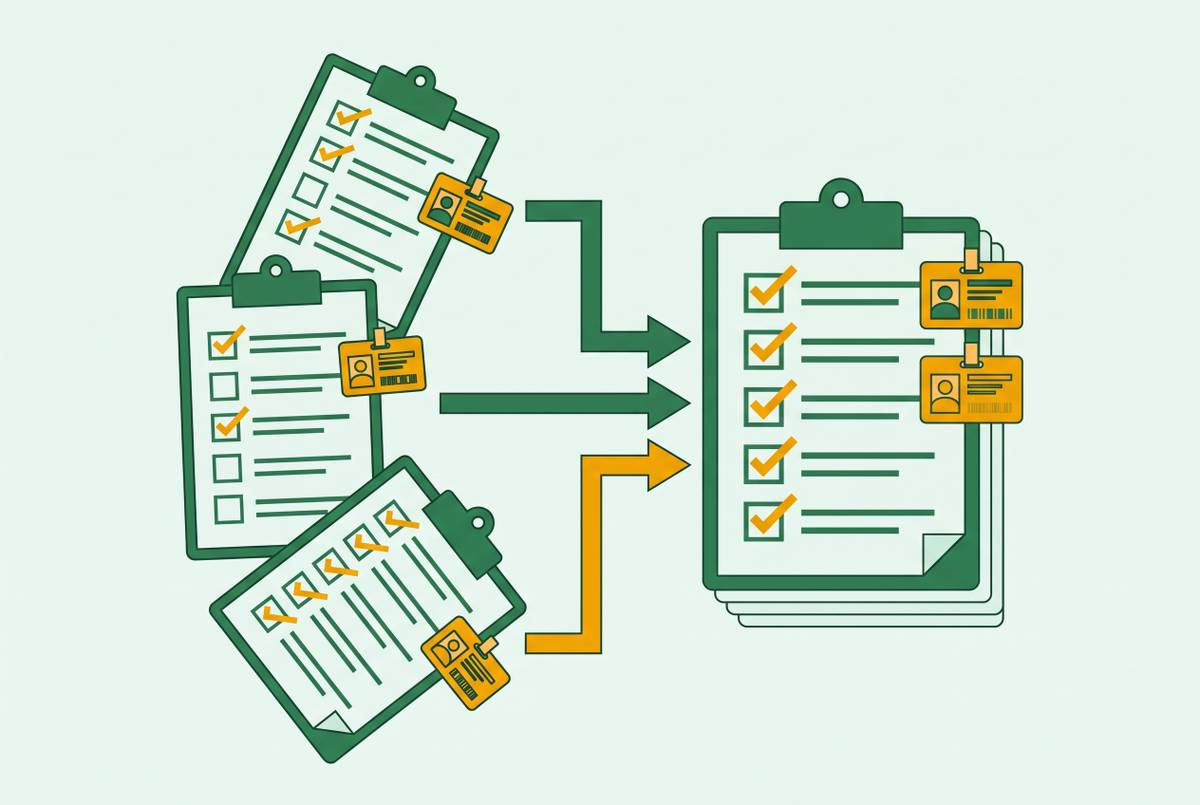
Conditional approval is a specific structure, not a shrug. It activates a contractor inside clearly defined limits while flagged documents are still outstanding, tracks those documents automatically, and locks in hard gates that block full authorization until the file is complete. Calling it a waiver would be wrong, and calling it an exception would also be wrong: it's a designed state with its own rules, its own clock, and its own escalation path.
Three pieces make it function as an actual system rather than a manager quietly looking the other way. First, a defined set of conditions spelling out which documents are allowed to be pending and which aren't. Second, automated tracking of whatever's still outstanding, with escalation that fires on a schedule rather than whenever someone remembers to check. Third, hard gates: automatic restriction or suspension the moment a deadline passes with nothing resolved.
Conditional branching, essentially routing logic, is the mechanism that produces all this. A contractor with incomplete paperwork gets sent down a different path than one whose file is fully credentialed, and the workflow literature on this (Moxo's model is one documented example) describes incomplete files triggering an automatic review-revise-resubmit loop instead of freezing the whole pipeline. Multi-level routing lets that happen in parallel too: one reviewer can be checking a background check disposition while another is confirming a training completion, so nobody's waiting in a single-file line behind a stalled document. And every step of it should leave a mark. What got approved, who approved it, under which specific conditional rule, and on what date, all of that belongs in an audit trail. The conditional window is a documented state.
Designing the permission matrix for which documents can be pending and which cannot
Not every missing document carries the same weight, and deciding which ones do is the single most consequential call in the whole workflow. Call it the permission matrix: the rule set defining which gaps get a conditional pass and which get a hard stop, full stop, no negotiation.
Some documents belong in the hard-stop tier because their absence creates exposure nobody can manage around. An active insurance certificate sits at the top of that list, a contractor working a route without confirmed coverage exposes the operator to exactly the liability the independent contractor agreement was supposed to shift away from them. A background check that's come back with a disqualifying flag, still sitting in review, is not a "manage it conditionally" situation, activating anyway is a compliance failure with a different name. And the W-9 or TIN belongs here too, since no payment can legally process without it. The 2026 shift in the 1099-NEC threshold to $2,000 under the One Big Beautiful Bill Act means fewer contractors will trip the automatic form-generation wire that used to catch this passively, which makes collecting the W-9 up front, inside onboarding itself, more important than it used to be, not less.
Other gaps can live in the conditional tier without much drama. A training module unrelated to safety-critical tasks. A photo of a vehicle or a scanned license copy when the primary identity and eligibility checks already cleared. A shipper-specific onboarding module for a shipper the contractor isn't yet assigned to. None of these, left pending for a few days, create the kind of exposure an insurance gap does.
The matrix itself needs to live on paper or in a system. If the audit trail has to document the conditional window, the rules governing that window need the same documentation, otherwise the trail just shows decisions with no rule behind them. And because different shippers often require different credential stacks, the matrix may need a configuration layer keyed to assignment type, not just to document category, since one client's "nice to have" is another client's "hard stop."
Structuring the conditional window: time limits, task restrictions, and escalation triggers
A conditional window with no expiration date isn't a compliance tool, it's an open-ended exception quietly collecting risk while nobody's watching the clock. Three structural elements keep it from turning into that.
Start with the clock. The window needs a real expiration. When that expiration hits and the document still isn't in, the contractor's active status should restrict or suspend automatically, no manual sign-off required to trigger it. The escalation schedule leading up to that point matters just as much: a six-step contract approval framework documented by Docupilot uses escalation triggers at 24, 48, and 72 hours, with automatic reassignment if an approver goes quiet, and the same cadence logic applies directly to contractor document reminders sent by email and text.
Task restrictions are where the window earns its keep operationally. A contractor missing a shipper-specific training module simply shouldn't be assignable to that shipper's routes for as long as the window is open, and that restriction has to be enforced where dispatch actually happens, at the assignment layer itself, not just noted somewhere in a compliance file. A flag that doesn't block the assignment isn't a guardrail, it's a note to self.
Outstanding documents should be chased in parallel, not queued one after another. Waiting for a background check to clear before even starting the insurance-certificate follow-up just stretches the window longer than it needs to be. And the audit trail has to be specific enough to answer who, what, when, and how. "Approved" on a record tells you nothing. "Conditional activation approved by [name] on [date], insurance certificate pending, restricted to non-Shipper-A routes, expiration set for [date]" tells you everything, and it separates a record that holds up under scrutiny from one that reads like an afterthought.
The compliance illusion objection: when conditional approval makes exposure worse
The strongest argument against conditional approval is this. A contractor activated conditionally is earning money before their file is complete, and if something goes wrong during that window, the operator may be worse off than if the contractor had simply been blocked. The conditional approval record doesn't defend anyone if the gap that mattered was insurance and insurance wasn't in place.
That objection lands hard, and it should. Some states require contractor agreements to state explicitly that the contractor carries their own tax and insurance responsibility, and activating someone before coverage is confirmed can undercut that transfer entirely, leaving the operator holding exposure the contract was supposed to move elsewhere. Gartner's Predicts report on contract automation makes a related point: risk climbs when teams bolt automation onto a workflow before the workflow design itself is finished. A conditional system running on an undefined permission matrix, or missing its hard gates, is worse than having no system at all, because it looks like management without actually being management.
The objection describes bad implementation, not the concept itself, so the answer is to fix the implementation rather than abandon conditional approval. Insurance sits in the hard-stop tier of the permission matrix for exactly this reason: a properly built matrix never allows conditional activation without confirmed coverage. Ongoing monitoring catches a lapsed certificate the moment it lapses and suspends automatically, rather than checking documents once at onboarding and never again. And the hard-stop alternative, blocking everyone until every document clears, doesn't make risk disappear either, it just hides it inside a pile of contractors sitting untracked and unresolved. There's a classification angle here too: a contractor whose file shows incomplete paperwork and no visible oversight is a much harder case to defend as a genuine independent contractor if that relationship ever gets examined. Visible management is the whole point. Informal management is the thing that gets operators in trouble.
Pay speed as a compliance variable: why the conditional window must include fast-pay infrastructure
Gate a contractor's pay until every document clears and the conditional workflow quietly turns into a retention problem. For an independent contractor, cash flow timing isn't a nice-to-have feature, it separates making the week's numbers work from not making them work.
Fuel, parking, vehicle upkeep, all of it lands upfront and immediately, while income on a standard payroll cycle does not. A majority of independent contractors say they'd switch platforms for a better payment experience. A conditional window that adds payment delay on top of an already incomplete onboarding just stacks friction on friction. The fix is to scope pay eligibility to whatever the contractor has actually been cleared to do, not to withhold it wholesale until the last document lands. Someone who's cleared the hard-stop tier and is conditionally active on a limited set of tasks should get paid for the work completed on that task set, full stop, no reason to make them wait on a training module that has nothing to do with payment eligibility. Gating pay over a document like that turns a compliance rule into a cash-flow penalty wearing a compliance costume.
The rails to make this work already exist. Same Day ACH moved a large volume of payments in the first quarter of 2026, up substantially from the year before, and FedNow, the Federal Reserve's instant payments system launched in July 2023, runs around the clock with real-time settlement and had its transaction limit raised again in November 2025. Instant debit and same-day ACH close the gap between finishing a route and actually seeing the money. Conditionally approved contractors can get paid for permitted work without waiting on a weekly cycle. On the reporting side, the 2026 threshold change means some contractors who previously triggered automatic W-9 collection will not, so the workflow needs to capture W-9 data at onboarding directly rather than relying on payment volume to prompt it, so that payment processing is never blocked by a preventable documentation gap.
Insurance coverage during the conditional window: occupational accident, commercial auto, and the gap contractors carry by default
Insurance is the one document category where a gap during the conditional window turns into direct, immediate liability, and any operator who hasn't nailed down exactly which coverage types are mandatory before activation has built a workflow with a hole in the floor.
Start with the gap contractors carry by default: independent contractors aren't W-2 employees, so workers' compensation simply doesn't apply to them. That gap exists because occupational accident coverage does not fill it, so a contractor hurt mid-delivery has no income replacement and only limited medical coverage, and whatever accident policy the platform runs typically only applies while the app is on and the delivery is active, leaving everything outside that window entirely on the contractor.
Three coverage types matter most for a delivery contractor network. Occupational accident coverage is optional but flexible, generally cheaper than workers' comp, and either the company or the contractor can pay for it. Zurich Insurance, as one example of how this coverage gets structured, rates it per mile, per delivery, per task, per hour, per day, per week, or per month, and can factor in earnings across every platform a contractor works on when it calculates disability benefits. Commercial auto liability covers vehicle incidents during active deliveries, and it belongs firmly in the hard-stop tier: there's no version of a delivery operation where activating someone without confirmed commercial auto coverage counts as a manageable gap. Cargo coverage matters for operators whose contractors are hauling goods with a declared value, and Great American Insurance Group is one example of a carrier building flexible options here, occupational accident, contingent liability, workers' comp, auto physical damage, aimed specifically at platforms and organizations running on independent contractor labor in transportation and delivery.
Buying insurance in bulk across hundreds or thousands of contractors, instead of leaving each one to source their own policy, tends to bring the per-contractor cost down substantially, and it solves something else at the same time: it gives the operator confirmed coverage at the moment of onboarding, which removes the certificate-chasing that creates conditional windows. Which points to the design rule that should never bend: commercial auto and occupational accident confirmation sit in the hard-stop tier of the permission matrix. No coverage confirmed, no activation, regardless of how clean the rest of the file looks.