Training Acknowledgment and Orientation Completion Tracking for Contractors
Delivery companies must prove contractors completed safety training when regulators ask.

Picture a delivery network running a few thousand contractors at any given moment, each one onboarded on a different day, some six months ago, some six hours ago. Every one of them technically completed an orientation at some point. Whether anyone can prove it, on demand, for a specific driver, on a specific date, is a different question entirely, and it's the question that matters when a regulator or a plaintiff's attorney comes asking. The independent contractor workforce in the U.S. has grown into the tens of millions, and delivery companies now run contractor networks at a scale where tracking any onboarding step by hand, training acknowledgment included, stops being realistic. That's a substantive problem, not one about paperwork. It's an operational fact: past a certain headcount, a spreadsheet and a filing cabinet cannot tell you who signed what and when.
The regulatory backdrop has shifted underneath this problem too. Federal and local authorities are sharpening the frameworks used to evaluate independent contractor relationships, and the standard that keeps surfacing across current guidance is blunt: consistent documentation and disciplined execution. Not intention. Not a well-meaning handbook nobody reads.
Delivery companies have historically treated orientation completion the way most people treat smoke detector batteries: something to deal with once, then forget. That framing is expensive. Done right, a training acknowledgment isn't a checkbox at all, it's a timestamped, auditable record that can answer three separate questions the moment someone under pressure asks them: was the contractor told about safety requirements, did they confirm they received that information, and when? Three questions, one record. The rest of this piece is about why that record has become load-bearing infrastructure rather than a filing formality.
The regulatory pressure that makes documentation non-negotiable
The federal test for who counts as an independent contractor has moved three times in under three years, which is roughly the legal equivalent of building on sand during an earthquake. Two years later, the Trump DOL proposed rescinding it, filing a Notice of Proposed Rulemaking on February 26, 2026, with public comments due by April 28, 2026, and the replacement standard leans back on two factors: how much control the company exerts, and how much opportunity the worker has for profit or loss.
That instability is the actual risk, more than any single rule. A company cannot lean on a federal standard staying put, so its documentation has to survive contact with whichever test happens to be governing on the day a dispute lands.
A structural wrinkle exists here. The proposed joint employer rule identifies control over employment records as one of four primary factors in vertical joint employment analysis. How a company keeps its contractor records, training documentation included, is squarely inside its classification exposure. Records sit inside classification as evidence, not as a footnote to it. They're evidence in it.
Local politics can move faster than any federal rulemaking process. The New York City Delivery Protection Act, under consideration as of May 2026, would force operators of last-mile warehouse and distribution facilities in the city to directly employ their core delivery and warehouse workers, which shows how a single city council vote can rewrite the IC relationship overnight. And audits increasingly turn on one plain question: did the hiring entity actually do a good-faith analysis, and can it show its work? Not "did it mean well." Did it document the reasoning. Regardless of federal direction, state-level enforcement persists, with California, New Jersey, and others maintaining their own classification standards, and per Worksuite, this enforcement does not pause while federal rules are in flux.
Misclassification exposure and the legal liability of untracked orientation
Misclassification isn't an abstract compliance term, it's a bill. Retroactive taxes, retroactive social security contributions, legal claims, all of it stacked on top of each other, and in a reclassification dispute the entire fight comes down to one question: what did the relationship actually look like in practice, not what the contract said it looked like.
Two behaviors reliably tip that scale toward "employee": making contractors sit through employee onboarding processes, and requiring them at staff-only events. Both blur a line that regulators are actively looking for reasons to erase.
Tracking that a contractor completed a safety orientation is not the same act as directing how they work. One documents that they independently received required information. The other controls their behavior on the job, and that control makes a company look like an employer in disguise. A training acknowledgment record built the right way, one that logs what information was delivered, confirms the contractor actively acknowledged receiving it, and treats completion as a condition of accessing the work rather than an instruction on how to perform it, actually reinforces the independent contractor relationship instead of eroding it.
Skipping the record means the company loses its ability to show it ever treated the contractor as an independent operator responsible for their own decisions. Regulators want proof that contractors are running something resembling a real, independent business, backed by more than a signature on a contract calling them one. A training acknowledgment record is a small but concrete piece of that proof.
What a defensible training acknowledgment record contains
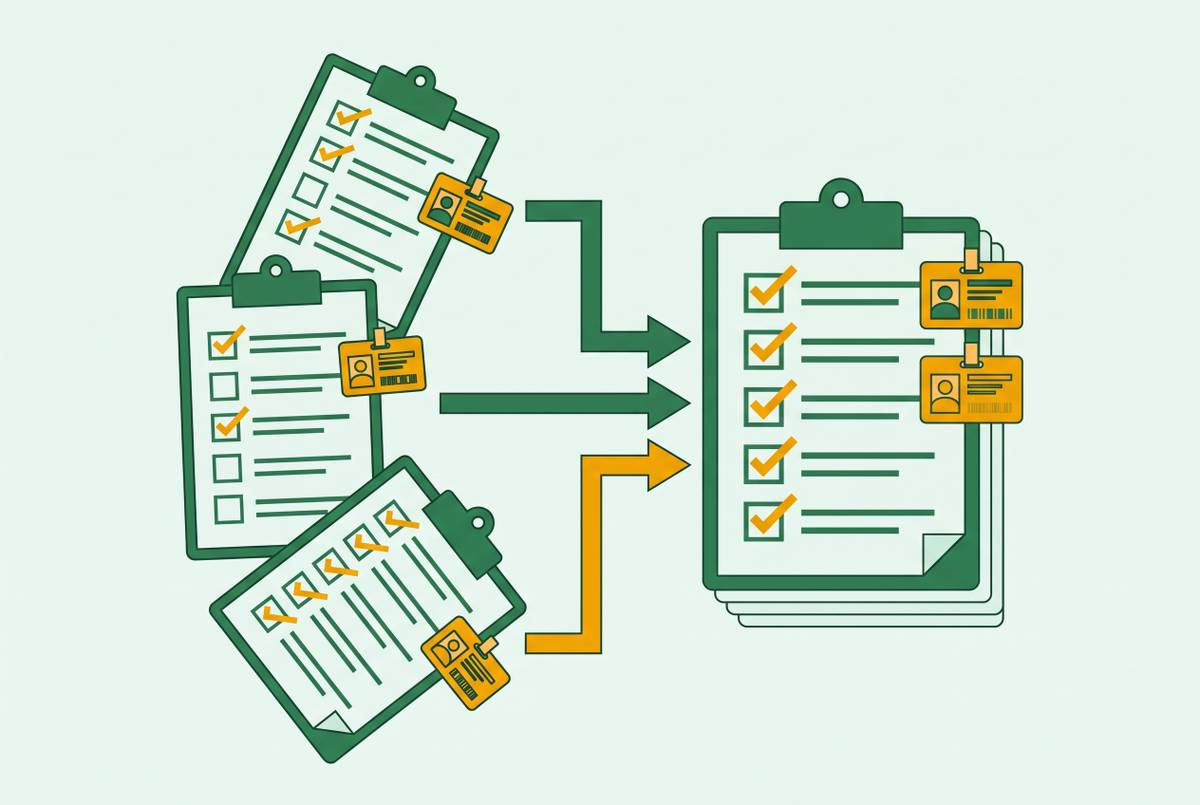
Walk through an audit scenario for a second. An investigator asks a delivery company to prove that a specific contractor, driver number whatever, was informed of their IC status and their safety obligations before their first shift. A company with a checkbox system produces a folder with a date stamp reading "orientation complete." A company with a defensible record produces something else entirely, including the specific content the contractor saw, the date and method it was delivered, an affirmative confirmation of receipt (not just a "completed" flag), and a verified match against the contractor's onboarding profile confirming it was actually that person who acknowledged it.
The content itself needs range. Safety requirements specific to the delivery environment: vehicle operation, cargo handling, injury reporting. The insurance coverage structure, spelled out clearly, including what occupational accident coverage applies, what it doesn't cover, and where the contractor's own vehicle coverage responsibility kicks in during non-dispatched hours. The IC relationship terms themselves state that the contractor sets their own schedule, can work for other clients, and owns their own tax obligations. And the operational policies: acceptable use, communication protocols, how disputes get resolved.
The acknowledgment has to be signed electronically, timestamped, stored somewhere that produces an immutable audit trail, and linked back to the contractor's onboarding profile so it can be pulled up fast under audit conditions, not hunted for. Version control is the point most systems miss. When a safety policy or an IC term changes, the system needs to flag exactly which contractors acknowledged the old version and which ones still owe a fresh acknowledgment, because an outdated signature on a policy that's since changed is nearly as weak as no signature at all. The same discipline that applies to manager training on classification principles, kept current and documented, applies here on the contractor-facing side.
The insurance dimension: why completion records matter to carriers and claims
Insurance exposure runs on a parallel track to regulatory exposure and is its own liability rather than a footnote to misclassification. Occupational accident insurance is the standard coverage layer for 1099 drivers who fall outside workers' compensation, covering medical expenses, disability income, accidental death, and dismemberment benefits, and it's the common substitute for workers' comp across trucking and last-mile delivery.
The exposure gets sharper when classification and insurance collide. If drivers classified as independent contractors get reclassified as employees down the line, claims can be denied and regulatory penalties triggered on top of it, a consequence entirely separate from the tax and legal fallout already discussed. A documented safety orientation supports the argument that the company took reasonable steps and gave the contractor informed knowledge of how the coverage stack actually works.
Coverage gaps are where this gets concrete. Hired and non-owned auto coverage fills the space that personal auto policies leave open when a contractor uses their own vehicle for deliveries, a gap that standard personal insurance simply doesn't cover once the vehicle is being used commercially. A contractor never told about that gap during orientation is more likely to be driving around assuming coverage they don't have, which is a safety problem and a claims problem stacked into one.
Scale, manual tracking, and the requirements of systematic completion monitoring
Somewhere in a mid-sized delivery network, a claims adjuster or a state investigator asks for one driver's signed acknowledgment from eleven months ago. The compliance manager checks the shared drive. The file's there, maybe. That's not a hypothetical failure; it's the default failure mode of any manual system once headcount gets large enough.
For a network running hundreds or thousands of 1099 contractors, all onboarded on different days, manual tracking produces exactly the kind of patchy record auditors are trained to spot: some files complete, some half-finished, some missing outright, none of it searchable in real time when someone needs an answer today. Policy changes make it worse. A manual system has no reliable way to flag which contractors signed off on the old safety policy and now owe a fresh signature on the new one. Adding in the churn of contractors leaving and returning, which is common in delivery networks, causes a manual system to almost always assume someone's acknowledgment is still current when it isn't.
The fix already exists in a different corner of the compliance stack. The same automation platforms use for tax documents, W-9 collection, TIN validation, eSignature, background checks, applies the identical logic to training acknowledgment: automated triggers instead of a person remembering to send a form, timestamped completion instead of a folder date, audit-ready export instead of a frantic file search. Finance and operations teams are being asked to manage bigger contractor workforces without growing their back-office headcount to match, and the only route through that math is process automation, not another hire.
Systematic completion tracking inside a contractor management platform
Training acknowledgment tracking shouldn't live in its own separate tool, disconnected from the rest of onboarding. It belongs in the same workflow as credential verification, background checks, and insurance confirmation, and it should gate contractor activation exactly the way a missing W-9 already blocks payment. No orientation acknowledgment, no dispatch. Simple as that.
A system built for this does a handful of specific things. It delivers orientation content automatically at the right point in onboarding, with no person having to remember to send it. It captures a timestamped, electronically signed acknowledgment tied to the contractor's profile. It gives operators a real-time dashboard showing who's current, who's overdue, and who's never acknowledged anything. It manages versioning, so when orientation content changes, the system knows exactly which contractors need to re-sign and starts that workflow without anyone chasing it manually. And it exports a full acknowledgment history, for one contractor or the entire network, the moment an audit calls for one.
Modular content structure matters here too. A network built around 25 or more onboarding modules can tailor orientation by contractor type, route, or cargo category while keeping the tracking logic identical across all of it. Real-time monitoring is the actual posture worth having, since a platform showing completion status continuously lets operators close gaps before they turn into liabilities, well ahead of a quarterly audit that catches problems three months after they started or a claim that forces the issue. And the same system tracking orientation completion should be tracking credential renewals, insurance verification, and payment status too. Splitting those into separate tools is how version drift and scattered files happen in the first place, and version drift is precisely what makes audit defense fall apart.
Turning completion records into a scalable compliance asset over time
One contractor's signed orientation form, sitting alone in a file, doesn't prove much. A network-wide, continuously updated acknowledgment history is a different thing entirely: it shows compliance is how the company actually operates day to day, not something assembled in a panic after a subpoena arrives.
In an audit or a reclassification fight, nobody's asking whether one driver's paperwork happens to be in order. They're asking whether the whole program is systematic, and the guidance on this point is direct: a well-structured program, backed by consistent documentation and disciplined execution, is the most effective way to manage that risk. The same completion records built for misclassification defense do double duty at insurance renewal time too, where carriers increasingly want to see evidence of real operational safety discipline.
Regulatory ground is not going to stop shifting, and contractor networks are not going to shrink back down to a size where a spreadsheet works again. Companies that build tracking infrastructure now get to treat the next rule change as a workflow, updating orientation content and re-acknowledging an entire contractor network in one pass, while companies still running manual systems treat every rule change as a fire drill. That's the actual difference systematic tracking buys: not paperwork done faster, but the standing ability to prove, on any given day, for any given contractor, that the company did what it said it did.
Sources
- Global Contractor Compliance 2025: How Smart Companies Are Different | Worksuite
- Contractor onboarding in 2026: What finance and HR teams need to know | CFO Dive
- DOL’s Proposed 2026 Independent Contractor Rule: What Employers Need to Know - Jackson Lewis
- Final Rule: Employee or Independent Contractor Classification Under the Fair Labor Standards Act, RIN 1235-AA43 | U.S. Department of Labor
- The Prove-It Era: When Training Records Become Legal Exposure
- How Do You Track Contractor Worker Safety Training Completion? | Simple But Needed