Multi-Client DSP Onboarding Requirements Reconciliation
Delivery companies juggling multiple clients face incompatible compliance demands.
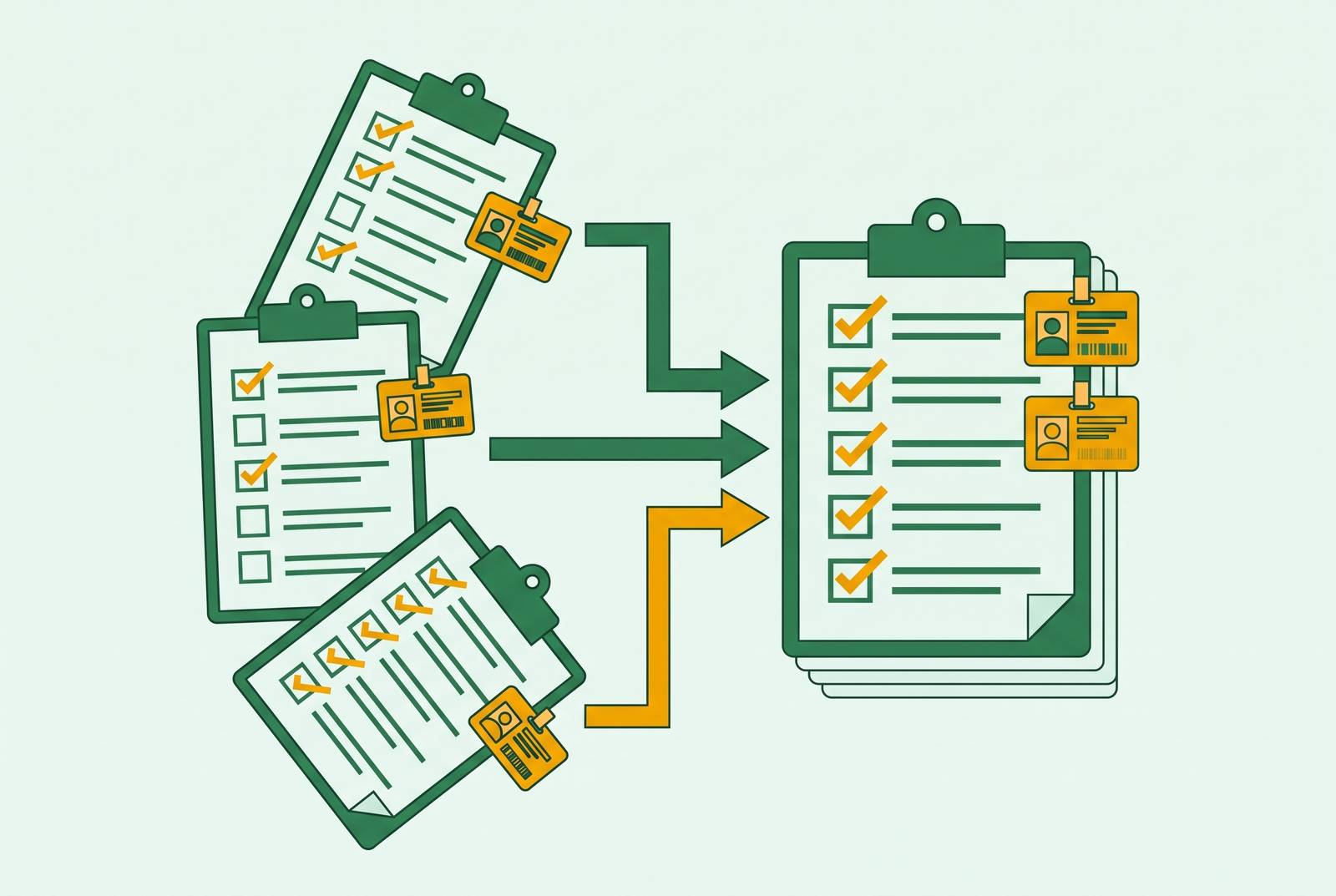
The delivery service partner model was built for one client. A DSP signed with a single retailer or platform, adopted that brand's technology, followed its rulebook, and ran its fleet accordingly. That arrangement is becoming the exception rather than the rule. The independence is the point of the model. It's also the reason multi-client onboarding turns into a genuine operational problem rather than a paperwork inconvenience.
The last-mile delivery market has grown rapidly year over year, valued at $184.2 billion in 2025, driven by e-commerce volume and rising consumer expectations for speed, and that growth is attracting more shippers and platforms into DSP contracting arrangements. At the same time, the independent contractor workforce has kept expanding, giving delivery companies a deeper pool of drivers to draw on and a stronger incentive to build networks that serve several accounts at once instead of running lean on a single contract.
DSP owners keep full control over hiring, daily operations, pay, and how fast they scale. DSP owners retain full independence in hiring, daily operations, compensation, and scaling, and when a second or third client account arrives, the DSP absorbs all the compliance and credentialing complexity that comes with it, without any client absorbing it for them. When that same owner picks up a second client, the client doesn't hand over a compliance team along with the contract. The DSP absorbs every bit of the new credentialing complexity itself, on top of whatever it was already running. Each client shows up with its own credentialing checklist, its own background check threshold, its own insurance minimum, and its own document flow, and those requirements overlap in some places, diverge in others, and occasionally collide. A DSP running two or three client accounts isn't running one onboarding process twice. It's running something closer to three different regulatory regimes through one driver pool, and most onboarding systems were never built to do that.
Where client requirements diverge
Client requirements sort into a handful of categories, but the standards inside each category are where the real friction lives, not the categories themselves.
Credentialing and licensing is the first flashpoint. Driver's license class, how recent an MVR pull needs to be, and background check depth all vary by client, and background check depth in particular covers lookback period, disqualifying offenses, and how adjudication gets handled. One client might accept a 3-year lookback window. Another might insist on 7. That's a meaningful distinction: two different investigations of the same person.
Insurance minimums diverge just as sharply. Commercial auto liability limits, occupational accident coverage, and cargo coverage thresholds are not standardized across the industry. Platforms including Amazon, FedEx, and UPS each set their own minimum coverage specifications for commercial auto, workers' compensation, and general liability as a condition of keeping the contract, and those floors are not the same floor from one platform to the next.
Training and safety requirements split clients into two camps entirely. Some demand a structured credentialing program before a driver ever takes a route. Amazon's Integrated Last Mile Driver Academy runs three days, two days of immersive station training plus one day on the road, and DSPs have to administer it before deployment. Other clients have no comparable requirement, or they run something structured but different in format. A driver credentialed for one account can be entirely uncredentialed for another, through no fault of their own.
Document collection, meanwhile, is where formats and expiration rules quietly diverge. Insurance certificates, vehicle registration, signed contractor agreements, and drug screen results are familiar documents, but acceptable formats and expiration treatment shift by client. Ongoing compliance adds another layer on top, since some clients want periodic re-checks and others want continuous monitoring of driver standing, with different thresholds for when a driver gets pulled off a route.
None of this is usually a flat contradiction between clients. It's more often an asymmetry: one client demands something the other simply doesn't ask for. Stacking every asymmetry together and applying every requirement from every client to every driver produces the heaviest onboarding process nobody actually needs.
Why separate onboarding tracks per client fail at scale
The instinct, when a second client account lands, is to build it a separate onboarding track. New client, new checklist, new folder. It feels safe because nothing from the first client gets touched. It also compounds the DSP's back-office load with every account added afterward.
Parallel tracks multiply manual work in a direct, countable way. Each track needs its own document collection, its own verification step, its own approval checkpoint, and its own compliance record, and any contractor who works more than one account has to move through more than one of these tracks separately. A driver who's been fully credentialed on one account still has to restart much of that work to pick up shifts on another, which produces exactly the kind of onboarding drop-off that costs DSPs retention, not just paperwork hours.
Parallel tracks also make compliance monitoring incoherent in a way that matters more than the administrative overhead. When a driver's insurance lapses or an MVR flag appears, the question is which track catches it first. If the tracks are siloed from each other, the honest answer is neither one, in time to matter. That's a compliance gap sitting inside the onboarding architecture itself.
Independent contractor classification risk is a consequence of this fragmentation. Misclassification carries real financial exposure, including fines and back payments covering wages, benefits, and taxes, and a fragmented onboarding setup makes it harder to show regulators a single, consistent, documented relationship with the contractor fleet. The regulatory ground is also moving, not sitting still. The regulatory environment is not static: the DOL proposed a new IC classification rule in February 2026, and state enforcement postures vary significantly, and a DSP with inconsistent onboarding documentation across client tracks is poorly positioned to respond to an audit or reclassification challenge. A DSP running inconsistent onboarding documentation across separate client tracks is in a weak position if an audit or a reclassification challenge arrives.
The scale math closes the case. A DSP picking up a third or fourth client cannot triple or quadruple its back-office headcount to match, and running parallel tracks means the back-office cost grows in a straight line with every client added. A unified process is the only structure where cost grows far more slowly than the client count does.
Mapping requirements across clients to find the union, the conflicts, and the gaps
Fixing this starts with an inventory, not software. Before a DSP builds anything resembling a unified onboarding process, every client's requirements need to be laid out side by side and sorted into what's additive, what's conflicting, and what's simply redundant.
A spreadsheet handles this fine. Rows cover credentialing and licensing categories: driver's license class, MVR recency window, and background check depth, including lookback period, disqualifying offenses, and adjudication standards; one client may accept a 3-year lookback while another requires 7. Columns are client accounts. Each cell holds the specific standard that client imposes. The point of building it this way isn't elegance, it's that the comparison has to be written down somewhere everyone can see it, rather than living in the memory of whoever handled the last client onboarding call.
Once the matrix exists, three outcomes fall out of it. Additive requirements are things one client asks for that another simply never mentions, so the unified process includes the requirement and every contractor completes it regardless of assignment, the union approach. Conflicting requirements arise when Client A and Client B both require the same category but at different standards, and the unified process must resolve the conflict, typically by adopting the stricter standard or by building a conditional module that activates only for the relevant account. Redundant requirements are the easy case, where both clients want the identical thing at the identical standard, so the DSP does it once and shares the resulting record.
Conflicts deserve the most deliberate handling because they can't be split down the middle. A background check with a 3-year lookback for Client A and a 7-year lookback for Client B cannot be averaged; the DSP either runs the 7-year check universally or gates the 7-year check behind assignment to Client B's routes. Either every contractor gets the 7-year check regardless of assignment, or the 7-year check becomes a gate that only activates for contractors assigned to that specific client's routes. Both are defensible. What's not defensible is leaving the conflict unresolved and hoping onboarding staff catch it manually every time.
The matrix also surfaces requirements a client only ever described in contract language or in a conversation, never translated into an actual onboarding step. Catching those gaps before a contractor is deployed against a client's routes is considerably cheaper than catching them mid-route, after a compliance failure has already happened.
Designing a layered onboarding workflow that satisfies every client without burdening every contractor
The matrix produces the material. What a DSP builds from it is a layered process: one universal baseline every contractor completes, plus account-specific modules that only switch on based on which client's routes a contractor actually works.
The universal baseline covers everything every client demands at a compatible standard: MVR pulled at the strictest common lookback window across clients, background checks run at the strictest common depth, core documents (W-9, license, insurance certificate), and the signed IC agreement. A contractor completes this exactly once, and that single record satisfies every client simultaneously. Nobody re-does the background check because they picked up a second account.
Account-specific modules sit on top and only trigger when relevant. Amazon's iLMDA completion is a clean example: it's required before a contractor can run Amazon routes, but it has no equivalent on other client accounts, so it becomes a conditional module tied to Amazon assignment rather than a step every contractor sits through regardless of who they're actually driving for. The same conditional logic applies to a client that sets a higher commercial auto liability floor than the baseline: the module prompts the contractor for an updated certificate meeting that specific floor before the system unlocks that client's routes for them.
This layered structure is what actually resolves the union problem instead of just naming it. A contractor working only one client account never touches modules built for a different client. A contractor working three accounts completes each relevant module exactly once, not once per account they happen to be assigned to. Sequencing keeps the whole thing auditable: the universal baseline gates access to any account at all, and each account-specific module gates access to that one account's routes, so the dependency chain is traceable end to end rather than a tangle of exceptions.
Document-sharing logic carries real weight here too. A background check, MVR, or insurance certificate that clears the universal baseline standard should be stored once and made visible to every client whose own standard it satisfies, with no re-collection of the same document under a second account's file. The architecture itself becomes a compliance asset as well as an efficiency gain. A consistent, documented process applied the same way across the entire contractor fleet, instead of ad hoc variation by client, supports the independent contractor relationship on its own merits, since classification determinations turn on the actual working relationship and the degree of control exercised over it.
Building insurance coverage into the unified process rather than treating it as a client-by-client problem
Insurance earns its own section because it's the category most likely to produce a genuine, load-bearing conflict between clients, and because the fix has structural features the general layered framework doesn't fully cover on its own.
Standard commercial auto insurance programs were built for other industries, not for last-mile delivery. The work calls for program architecture built around platform contract requirements, urban frequency-driven loss profiles, and a workforce that mixes employees, DSP contractors, and gig couriers under one operation. Multiple clients layered on top compound the mismatch, since each platform, Amazon, FedEx, UPS among them, sets its own minimum coverage specifications for commercial auto, workers' compensation, and general liability, and those floors are not identical from platform to platform. A certificate that clears one client's minimum can fail another's.
Occupational accident coverage adds a wrinkle specific to contractor status. Independent contractors generally aren't eligible for traditional workers' compensation, so occupational accident coverage serves as the practical substitute, and clients don't always agree on whether the DSP or the contractor should carry it. That's a question a DSP needs answered before onboarding, not discovered after an injury claim.
The reconciliation logic mirrors the conflict-resolution approach from the broader onboarding framework: identify which client sets the highest coverage floor in each category, build the DSP's baseline insurance requirement around that highest floor, and confirm during onboarding that the coverage certificate produced clears every client's minimum at once. A high-water-mark standard, applied once, replaces a certificate-by-certificate reconciliation exercise that otherwise has to happen every time a contractor picks up a new account.
Coverage products built for this workforce already reflect that logic. Great American Insurance Group offers flexible coverage options including Occupational Accident, Contingent Liability, Workers' Compensation, and Auto Physical Damage, and the combination of coverage types matters when different clients have different liability exposure expectations. The onboarding implication follows directly: insurance verification belongs inside the automated universal baseline, with any client-specific certificate requirement surfaced as a clearly labeled conditional step, not left for someone to chase down by email after a contractor has already been assigned a route.
Keeping the unified process current as client requirements and the regulatory environment change
A unified onboarding process isn't a project with a finish line. It needs a standing mechanism for catching requirement changes and pushing them through before a contractor ends up working a route out of compliance.
Client requirements move on their own schedule. Platforms revise their minimum standards, add new training requirements, or change background check parameters without much warning, and a DSP that finds out after a contractor is already on the road faces retroactive remediation across the whole fleet rather than a clean update at the front door.
The regulatory backdrop is shifting in parallel. A new IC classification rule proposed on February 26, 2026 would rescind the 2024 economic reality framework and return to a five-factor economic reality test with two core factors, control and opportunity for profit or loss, given elevated weight. A change at that level doesn't just affect paperwork. It can reshape what "documented relationship" needs to look like to hold up under review.
The requirement matrix built earlier isn't a one-time artifact for exactly this reason. It has to be revisited whenever a client updates a standard, whenever a new client account joins the portfolio, and whenever the regulatory floor itself moves, with each change traced through to the universal baseline or the relevant conditional module rather than patched in as a one-off exception. DSPs that treat the matrix as a living document are positioned to absorb the next client account and the next rule change without rebuilding the process from scratch.