Reducing Contractor Onboarding Time From Weeks to Days
Automation eliminates handoff delays between compliance, credentialing, and payment setup.
MBO Partners' 2025 State of Independence report puts the number at 72.9 million people working independently, or 36% of the entire U.S. workforce. That is a major share of the workforce. They are competing for workers who can afford to be picky.
For a last-mile delivery company, this turns onboarding speed into a genuine competitive weapon rather than a back-office metric nobody checks. A contractor who is insured, credentialed, and ready to drive but stuck waiting on paperwork is not neutral inventory sitting on a shelf. Every idle day is a day a competitor's app pings that same driver with a faster path to their first route. Slow onboarding is not an inconvenience, it is a route-loss event, and in markets where driver supply is tight, that loss is permanent. What follows is a breakdown of exactly where onboarding time actually goes, which bottlenecks eat the calendar, and how automation collapses weeks into days. Full-time independents more than doubled, from 13.6 million in 2020 to 27.7 million in 2024, meaning delivery networks are competing for a contractor workforce that has genuine options and expectations.
The real timeline of a manual contractor onboarding process: "weeks to days"
The costs of manual onboarding are visible across staff time, document processing, and compliance verification rather than in a single line item. SHRM's 2025 Human Capital Benchmarking Report puts the average administrative cost at $4,129 per hire, covering staff time, document processing, and compliance verification. Brandon Hall Group tacks on another $8,300 in lost productivity for the gap between the day someone accepts an offer and the day they're actually contributing at full capacity. Adding those together means a slowly onboarded contractor costs an operator $12,429 before they've delivered a single package.
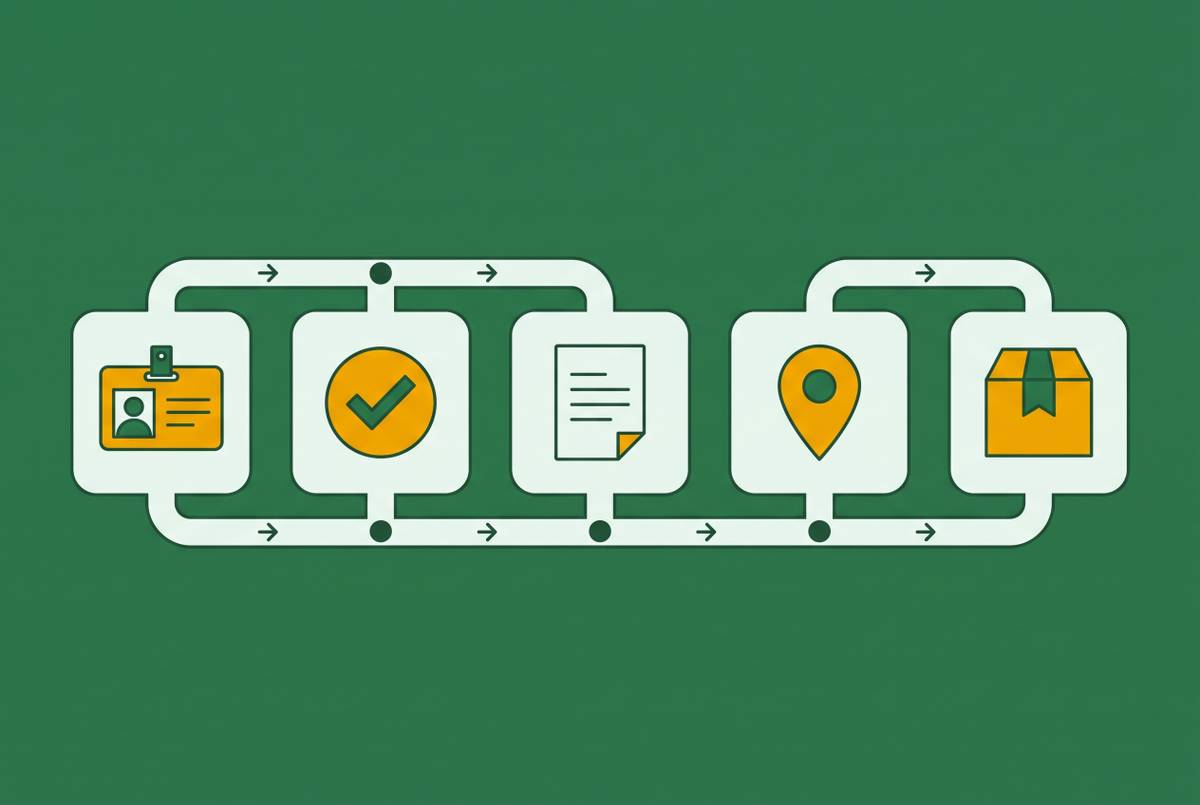
The sequence itself explains why. A contractor applies, a recruiter reviews the application by hand, and follow-up emails go out chasing whatever document is missing. Background checks, motor vehicle record (MVR) checks, and drug screens get ordered separately, and results arrive on different timelines. Insurance enrollment only starts once credentialing clears, so it inherits every delay that came before it. Payment setup, the part where someone collects a W-9, bank details, and a pay method, often lands with a completely different team and gets handled last. SHRM's 2025 data shows the average company burns 10.4 hours of administrative staff time per new hire just on document collection, provisioning, and paperwork. None of this is a single failure. It is a structural one: no single system owns the process end to end, so it spans legal, finance, IT, and operations, and at every handoff between those departments, accountability quietly disappears and idle days pile up.
This is not a story about lazy coordinators or sloppy recruiters. A process that limps along fine for five contractors a week collapses completely at fifty. Volume doesn't create new problems, it just exposes every seam that was already there, waiting to be pulled apart.
The five specific bottlenecks that consume most of the onboarding timeline
Document collection and chasing comes first, and it is the most mundane bottleneck precisely because everyone assumes it's already solved. Email-based requests for W-9s, government ID, insurance certificates, and signed contracts turn into a back-and-forth that stretches across multiple days per contractor.
Second is the credentialing stack. For delivery drivers specifically, this is where the real time goes. Each of those checks needs its own verified result before the next step can begin, and when they're ordered one at a time rather than simultaneously, the credentialing stack alone swallows the majority of the onboarding calendar.
Third, insurance enrollment lags behind everything else because it's structurally downstream. Occupational accident and commercial auto coverage can't activate until credentialing clears, so any delay upstream gets inherited and amplified. And because enrollment is usually manual, every contractor touches someone's inbox again, and the queue grows faster than staff can clear it.
Fourth is tax form collection, which sounds administrative until it blocks a paycheck. A W-9 for domestic contractors or a W-8 for international ones has to be collected before the first payment goes out. Defer it, and it doesn't just delay pay: it raises 1099 filing risk that becomes visible at year-end. The IRS 1099-NEC reporting threshold rises from $600 to $2,000 starting tax year 2026 under the One Big Beautiful Bill Act, but that change does nothing to the obligation to collect the W-9 before that first payment, and the penalty for failing to file remains roughly $330 per form Gig Economy in 2026: Five Forces Reshaping Platform Hiring IRS 1099 Reporting Threshold Changes for 2026 1099 Filing Rules for 2026: A Complete Guide for Businesses.
Fifth, payment setup itself tends to get treated as an afterthought. Bank details, pay method selection, and pay schedule configuration get handled last, often by a team that's separate from whoever cleared the contractor to work. A driver who finishes their first route and then waits days to get paid has a very concrete reason to open a competitor's app instead.
None of these five bottlenecks is inherently slow Gig Economy in 2026: Five Forces Reshaping Platform Hiring. They're slow because manual processes run them one after another, in series, when there's no structural reason they couldn't run at the same time. The industry standard involves 7-year criminal background checks and 3–7-year driving record reviews that vary by state, clean record thresholds of no more than 2 moving violations in 36 months, and DUI disqualification windows of 5 years, with each criterion requiring a separate verified result before the next step begins.
Automated workflows compress onboarding by running compliance, credentialing, and payments in parallel
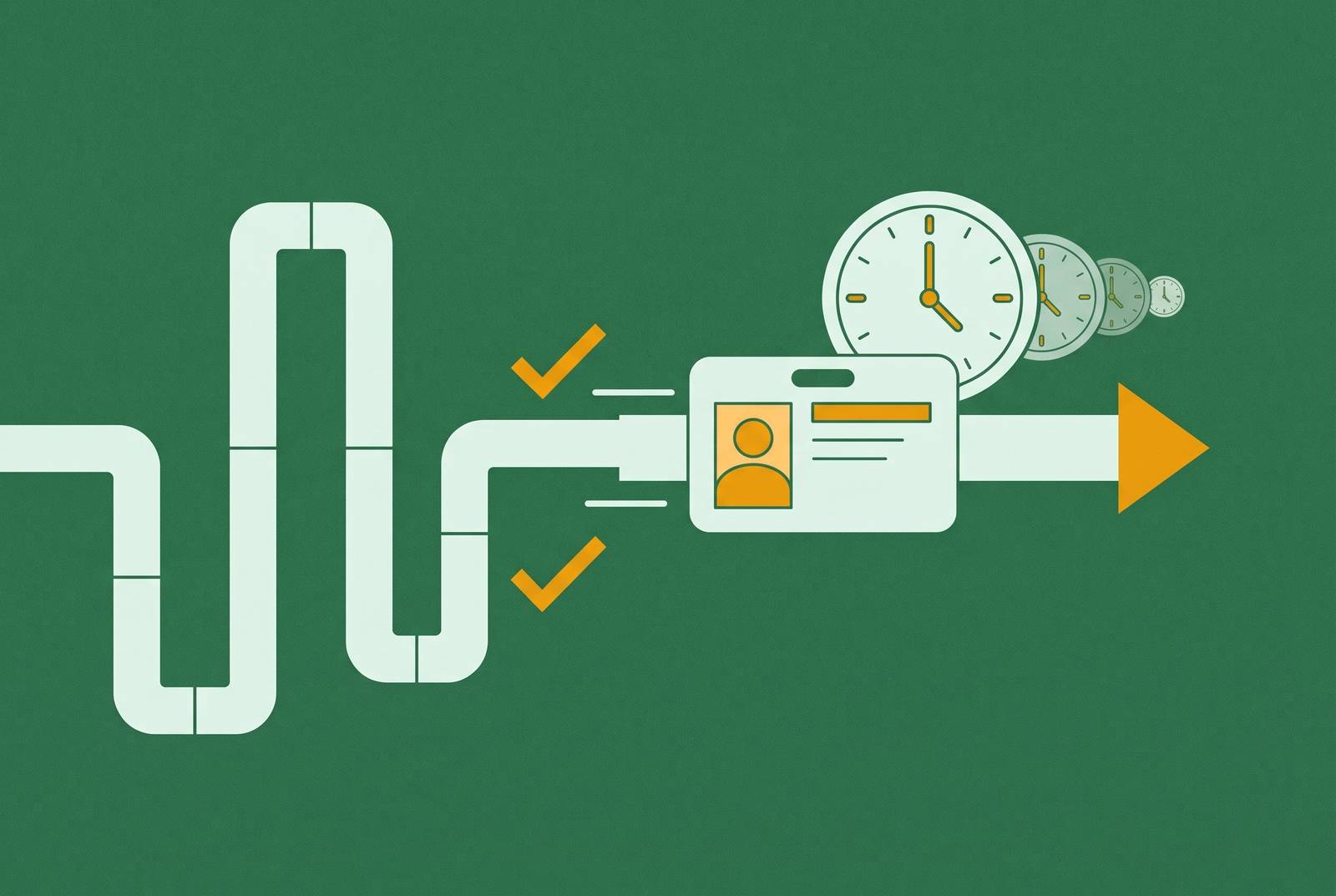
Automation doesn't make any single task faster. Ordering a background check through software instead of a phone call takes roughly the same number of days either way. What automation eliminates is the idle time sitting between tasks, the gap where a completed step waits for a human to notice it's done and manually kick off the next one. The system triggers the next step the moment the prior one resolves, with no handoff required.
Structured intake forms handle document collection by rejecting incomplete or misformatted submissions the moment they're submitted, rather than after a coordinator opens the file a day later. Automated reminders replace the manual follow-up email, and the system does the chasing instead of the coordinator. Credentialing checks fire simultaneously, running on a parallel track. Results land in a compliance dashboard that flags exceptions, so staff review the cases that need judgment instead of reading every clean report that doesn't.
Insurance enrollment stops depending on a staff member remembering to notice that credentialing cleared. The rule is simple: credentialing status changes to cleared, the enrollment packet fires. Because coverage terms are pre-negotiated through bulk purchasing arrangements, enrollment becomes an activation rather than a fresh quote that has to be requested and waited on. And tax and pay setup happen where they should have happened all along, at the application stage rather than after credentialing clears. W-9 collection, pay method selection, and bank details get entered while the contractor is filling out their initial application, not bolted on weeks later. That timing is also what makes automated 1099-NEC generation at year-end possible, since compliance that starts at onboarding means the tax documentation already exists when it's needed.
Brandon Hall Group research found organizations running automated onboarding see 54% greater new-hire productivity. This is a process redesign that requires rethinking how the work happens. Automation enforces a sequence and a structure that manual teams, however competent, cannot sustain once volume climbs.
Continuous compliance monitoring replacing the assumption that onboarding is a one-time event
The old model treats onboarding like a single checkpoint: verify identity and credentials once, stamp the file, move on. That model stopped being defensible the moment contractor workforces started cycling rapidly between platforms. An MVR that was clean at hire can pick up a violation eight weeks later https://fadv.com/article/gig-economy-2026-five-forces/. A criminal record can change. Insurance can lapse mid-contract without anyone in the operator's office finding out until a claim gets filed. A credential that was valid on day one says nothing about its validity on today's route.
Identity fraud makes the problem worse, not better. Gartner projects that as many as one in four candidate profiles could be fake by 2028, and deepfake-as-a-service became one of the fastest-growing cybercrime tools of 2025. The relevant question has quietly shifted from "did this person pass the background check" to "is this still the same person who passed it." That's a harder question, and it's not one a one-time verification can answer.
Regulators are not waiting for operators to catch up. Local rules like this can change an operator's compliance obligations mid-engagement, without warning and without regard for whatever timeline the operator had in mind. Continuous, real-time monitoring is the only structure built to catch this kind of thing as it happens: a system that alerts the day an MVR lapses or an insurance certificate expires, rather than surfacing the problem at the next quarterly audit. An operator whose compliance stack flags a disqualifying event before the route leaves the lot sidesteps a liability event that a less-automated competitor is going to eventually walk straight into. The DOL concluded over 17,000 wage and hour violation cases in 2024, with enforcement remaining active even as federal classification guidance has shifted. NYC's Delivery Protection Act (Int 0518-2026), sponsored February 2026, would require delivery operators to obtain a business license including safety, training, and employment requirements, and Mayor Zohran Mamdani voiced support on August 10, 2026, showing how local-level requirements can change the compliance obligation mid-engagement.
The classification layer: how fast onboarding and real-time monitoring reduce IC misclassification exposure
Misclassification isn't a line item; it can unwind an entire operating model through back taxes, penalties, and litigation that outlasts the contractor relationship it started with. The federal picture doesn't offer much comfort either way. The Trump administration's DOL issued contractor-favoring enforcement guidance in May 2025 (FAB 2025-1), which paused enforcement of the prior six-factor test without formally rescinding it, and a proposed rule meant to replace it wasn't published until February 2026 Gig Economy in 2026: Five Forces Reshaping Platform Hiring. An operator hoping for one clean federal standard to hide behind is going to be disappointed.
Automation contributes something specific to a misclassification defense, and it's not just speed. A documented statement of work, collected at the moment of onboarding, establishes the terms of the IC relationship from day one, rather than being reconstructed after the fact when a regulator asks for it. Automated workflows generate timestamped audit trails for every document, every check, every signed agreement, which is exactly the kind of paper trail regulators ask for during an investigation. Running the identical process on every contractor removes the ad hoc variation, such as the case where one driver got a verbal agreement and another got a signed one, and that variation draws scrutiny.
The IRS 1099-NEC reporting threshold rises from $600 to $2,000 beginning tax year 2026, indexed for inflation starting in 2027, meaning operators need to update their payment trigger logic accordingly IRS 1099 Reporting Threshold Changes for 2026. And any operator with cross-border exposure has the EU Platform Work Directive to contend with: adopted in October 2024, it requires all 27 member states to write their own rebuttable presumption of employment into national law, with a transposition deadline of December 2, 2026. Twenty-seven countries implementing the same directive differently guarantees that the rules an operator follows in one country won't match the rules next door. Automation doesn't just make onboarding faster, it makes the classification position defensible at every layer someone might eventually look at it.
Contractor onboarding software features built for delivery and IC networks
General HR onboarding tools were not built for the requirements that delivery and IC networks have. That distinction matters more than most buyers realize before they've signed a contract they later regret.
The document flows need to be 1099-specific from the ground up, covering W-9 collection, MVR ordering, criminal background checks, and drug screening built for contractor onboarding rather than repurposed from payroll onboarding. Credentialing depth matters just as much, and the real test is that the platform enforces the seven-year criminal check window, the three-year MVR window, and the two-moving-violation threshold as automated rules rather than manual reviews. Insurance needs to live inside the same workflow rather than requiring a separate vendor relationship that someone has to remember to check. Pay speed is not a minor feature: instant debit and same-day ACH function as retention tools as much as payment mechanics, and the platform needs to support both. Real-time compliance monitoring and the ability to handle hundreds or thousands of simultaneous onboardings without adding back-office headcount round out the list.
A handful of named platforms serve pieces of this puzzle. Openforce is listed as best for gig economy management by People Managing People's 2026 review, built specifically around IC workforce compliance, payments, and onboarding, with pricing available on request. Deel Hire earns the same publication's pick for centralized onboarding flow, and it's strongest where global payroll and international contractor compliance are the priority, starting at $29 per employee per month and running up to $599 for employer-of-record services, though it's designed for breadth across global hiring rather than delivery-specific credentialing depth. Gusto is the pick for small businesses, starting at $49 a month plus $6 per user, which suits an early-stage operator fine but wasn't built for high-volume credentialing at scale. Papaya Global unifies onboarding, invoicing, and payments into one workflow and is strongest for international contractor operations.
For a delivery company or IC-network operator specifically, the strongest fit is a platform purpose-built for the 1099 contractor lifecycle (one that integrates onboarding, credentialing, compliance monitoring, insurance, and payments in a single workflow rather than requiring operators to stitch together multiple point solutions). Everee is a payroll platform combining W-2 and 1099 contractor payroll, automated tax filings, and same-day payment processing, noted as a strong fit for high-volume 1099 contractor payments on flexible or daily schedules (People Managing People).
Auditing your current onboarding process and identifying where to automate first
Start by timing the actual process, the one that runs regardless of what leadership believes is running. Most operators discover the elapsed time is longer than anyone in the room would have guessed, and the gaps between steps, not the steps themselves, account for most of it.
Then map ownership. For each of the five bottlenecks (document collection, credentialing, insurance, tax forms, payment setup) name the single team responsible for triggering the next step Gig Economy in 2026: Five Forces Reshaping Platform Hiring. If the honest answer is "it depends who checks their inbox first," that's the handoff to automate first, because it's the one bleeding days without anyone being accountable for the bleeding. Rank the five bottlenecks by how many idle days each one adds, and start with whichever one is currently worst Gig Economy in 2026: Five Forces Reshaping Platform Hiring.
Sources
- Gig Economy in 2026: Five Forces Reshaping Platform Hiring
- 10 Best Contractor Onboarding Software Reviewed in 2026
- IRS 1099 Reporting Threshold Changes for 2026
- 1099 Filing Rules for 2026: A Complete Guide for Businesses
- US Department of Labor issues guidance on independent contractor misclassification enforcement | U.S. Department of Labor