Document Retention Schedules for 1099 Contractor Files
Know which documents to keep and for how long.

A single contractor engagement generates seven distinct document types, and each one has to answer to a different statute. That is the operational reality behind "Document Retention Schedules for 1099 Contractor Files," and it is why the three-year rule most business owners grew up with does not survive contact with an IC network. If income was reported fully and accurately, the standard IRS guidance gives you three years from filing under IRC §6501(a). Contractor networks rarely sit inside that clean a box, because a single engagement produces a classification determination, a written contract, a W-9 or W-8, one or more 1099-NEC filings, insurance certificates, credentialing records, and payment records, each one governed by its own legal authority. Treating that stack as one undifferentiated pile makes an operator over-retain the documents that carry no risk while under-retaining the ones that carry all of it; only a unified schedule, mapping every file type to its own clock, can fix that mismatch.
The IRS statute tiers that set the retention floor for every file type
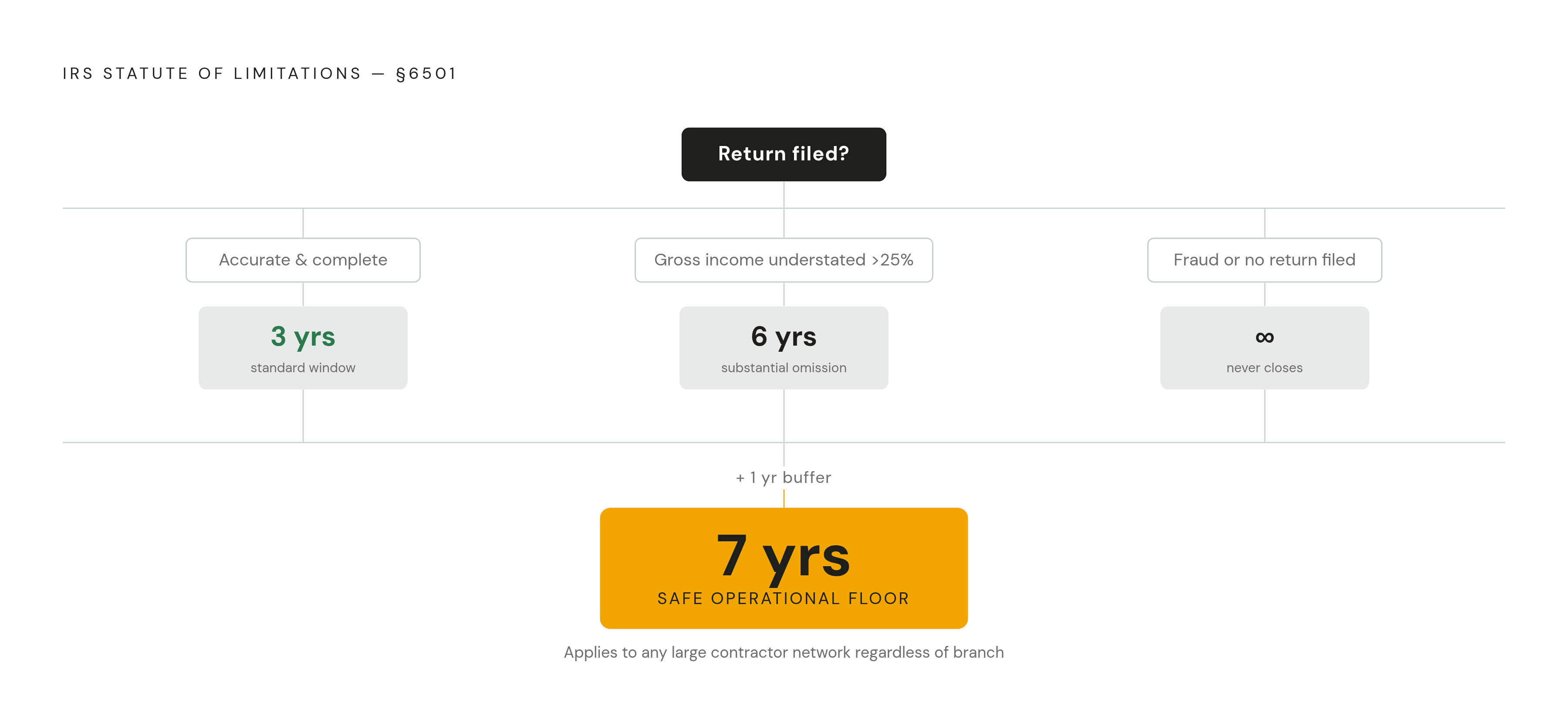
The IRS statute of limitations works less like a single deadline and more like a branching decision tree, and which branch applies to a given file depends on what that file documents and whether the income behind it was reported straight. Under IRC §6501, the default window is three years. Understate gross income by more than 25% and the window extends to six years. File a fraudulent return, or fail to file at all, and no window ever closes. For a company running a large contractor network, that six-year tier is not some remote hypothetical. When 1099-NEC filing is inconsistent across hundreds of contractors, or a payment record fails to reconcile against a filed return, that is exactly the kind of error that can trip the extended window on any given tax year. Most CPAs handle this by building in a buffer: take the six-year substantial-omission window and add one year, landing on seven years as the practical floor for business tax records. That seven-year number is the rational response to an operator's actual exposure profile, where the three-year baseline assumes a level of reporting accuracy that a thousand-contractor payment system cannot always guarantee on the first pass. One operational note removes a common excuse for poor recordkeeping: digital storage is fully equivalent to paper under IRS guidance, so long as the system reproduces records accurately and completely, indexes them for retrieval, controls against alteration, runs a quality-assurance program, keeps an audit trail, and gives the IRS unrestricted access. Photos and PDFs stored in a system that meets those conditions satisfy the standard as well as a filing cabinet ever did, so there's no excuse rooted in storage format for falling short of seven years.
How the 2026 threshold change affects mandatory filing triggers
For 2026, the 1099-NEC reporting and backup withholding threshold rose under the One Big Beautiful Bill Act, but the backup withholding rate held steady at 24%. That change shifts which contractor relationships trigger a mandatory filing, and it stops there. It does not touch the retention clock on payment records already sitting in the system, and it does not touch the clock on relationships that happen to cross the new line. A contractor paid below the 2026 threshold will not generate a mandatory 1099-NEC, but the payment records for that relationship still sit in the operator's books, and they still feed audit exposure once income reconciliation gets questioned by the IRS or a state agency. You still have to collect the W-9 or W-8 at onboarding, no matter whether a given contractor will eventually cross the filing threshold. Collecting the form before the first payment goes out guarantees the record exists later, when an audit shows up asking for it. Operators that build a "no valid tax form, no pay" rule into onboarding cut their year-end compliance burden substantially, because the platform captures and verifies the right form before money moves.
Why classification records require the longest hold
Worker classification is the file category that deserves the most aggressive retention treatment: a misclassification challenge can reach back across every open year at once, and the regulatory ground underneath classification standards keeps shifting. Few corners of employment law have moved as fast. In under three years, the Department of Labor's governing test for independent contractor status changed at least twice, and a third change is now proposed. In May 2025, the DOL issued Field Assistance Bulletin 2025-1, instructing investigators to stop applying the 2024 rule. In February 2026, the DOL went further and formally proposed rescinding that 2024 rule, replacing it with a framework built around two factors: control over the work and the worker's opportunity for profit or loss. Each shift reopens prior classification decisions to fresh scrutiny, so if an investigation can span several years of changing standards at once, you need documentation covering the full seven-year audit window as your only durable defense. State law adds separate, overlapping standards that operators must track in each jurisdiction. On May 5, 2026, New Jersey finalized regulations applying the ABC test to independent contractor status under its Wage and Hour Law and Wage Payment Law, effective October 1, 2026. California imposes penalties per misclassified worker, and Minnesota has its own separate per-misclassification penalty structure on the books. If you run contractors across state lines, you are not defending one classification standard. You are defending against several, each one able to move on its own schedule.
The classification file itself needs to hold five things: the written independent contractor agreement, a multi-factor analysis or classification memo showing how the determination was made, any Form SS-8 correspondence, evidence of the economic reality factors assessed at the time of engagement, and records of any reclassification decision made later. The recommended hold is seven years from the end of the contractor relationship, which matches the safe-default IRS audit window described above. Any relationship that was formally reclassified, or that generated correspondence with a regulator, should be kept indefinitely rather than purged on the standard clock, because that is precisely the kind of file a future investigation will go looking for first.
The correct retention windows for 1099-NECs, contracts, and payment records
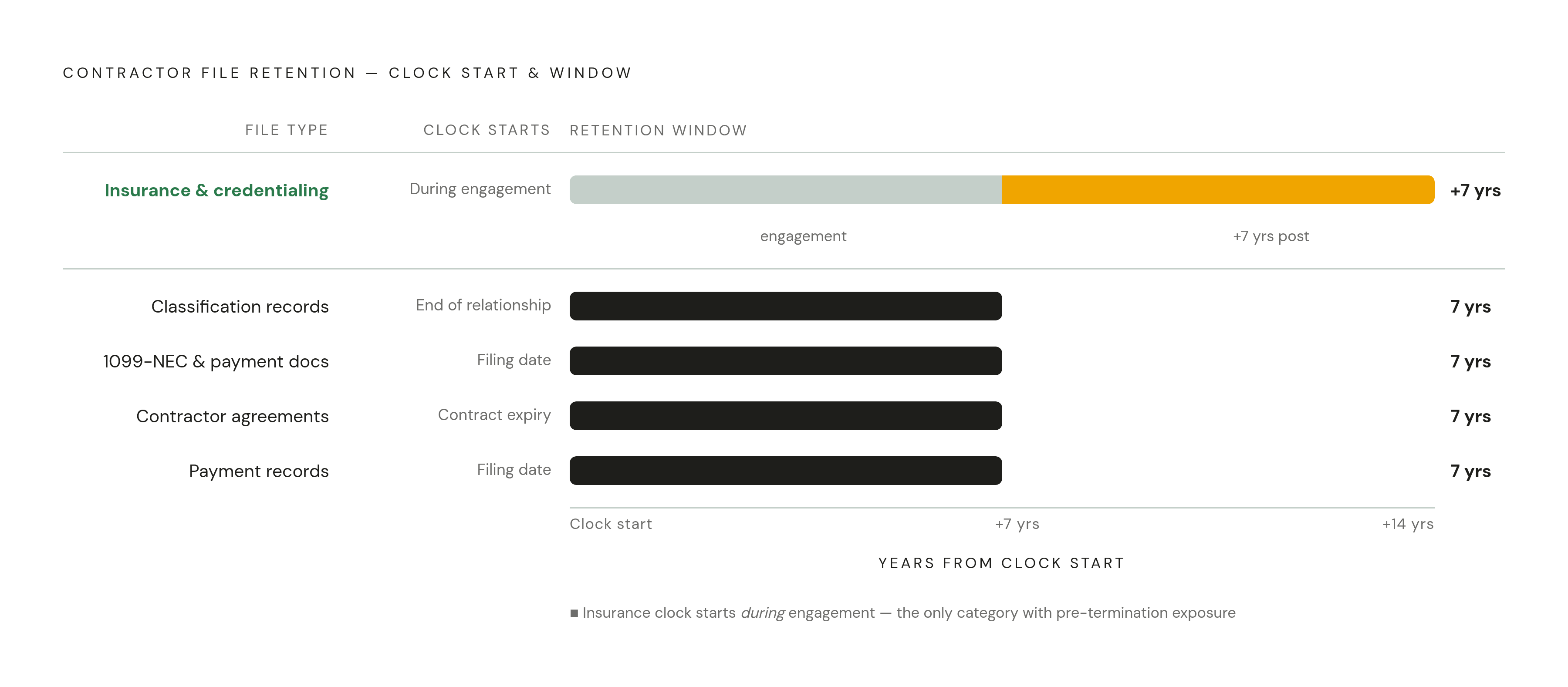
Seven years is the right default hold for the three highest-volume file types in a contractor network, but the clock starts at a different point for each, and the required contents differ too.
You should hold 1099-NEC forms and their supporting payment documentation for seven years from the filing date of the return year in which the payment was reported, which covers the six-year substantial-omission window plus a one-year buffer. The file needs the filed copy of the 1099-NEC itself, the underlying W-9 or TIN verification, the payment record that reconciles to the reported amount, and any backup withholding documentation tied to that contractor. The IRS's own guidance on employment tax records, including W-2s, recommends at least four years after the tax becomes due or is paid, whichever comes later. Most practitioners stretch that to five years as a baseline and treat seven as the conservative standard for any business running a large contractor network.
Contractor agreements carry a different clock: seven years after the contract expires or terminates, covering the period during which a dispute over terms, scope, or classification could still be litigated or audited. That file needs the signed agreement, any amendments or renewals, statements of work, and whatever documentation exists from termination or offboarding.
Payment records match the 1099-NEC timeline at seven years, because you need them as the primary reconciliation evidence if a reported amount is ever challenged. Instant-payout rails complicate this slightly without changing the obligation. RTP and FedNow transactions each generate a timestamped, rail-specific record, and you need to retain it and integrate it with the broader 1099 documentation file. The payment medium does not change the underlying rule. Bank statements and deposit records carry a shorter three-year window on their own, but once those records feed a 1099 obligation, the seven-year standard takes over.
Insurance certificates and credentialing records as live compliance files
For delivery and last-mile operators, insurance certificates and credentialing records don't behave like tax documents, because they expire mid-engagement and have to be refreshed while the contractor is still active. A tax record is a snapshot. An insurance certificate is a subscription, and treating it like a snapshot is how coverage gaps slip through unnoticed.
The stakes around that gap got sharper in 2026. The U.S. Supreme Court's May 2026 ruling in Montgomery v. Caribe Transport II, LLC turned negligent hiring into a question that now reaches the board for freight brokers and logistics operators. Enterprise customers in medical courier, pharmaceutical delivery, clinical trial transport, and regulated HazMat operations are now under real pressure to show that their contractors are credentialed, qualified, and monitored on an ongoing basis, not just checked once at signing. What that means for a retention schedule is that the file has to capture every renewal, every lapse notice, and every re-verification event across the life of the engagement, not merely the certificate that was in force the day the contractor was onboarded. A lapse that went undetected and unaddressed is itself evidence in a negligent hiring claim, regardless of whether the contractor was actually at fault for whatever triggered the claim.
The recommended hold here is the life of the engagement plus seven years, matching the rest of the contractor file, because insurance policies fall into the standard seven-year category once they expire. Continuous monitoring, meaning automated alerts when a license lapses or a certificate expires, turns a static file into something closer to a living record. The monitoring log itself, what was checked, when it was checked, and what action followed, belongs in the retention file as much as the certificate does.
How scale and payment automation change what retention requires
If you run a contractor network in the hundreds or thousands, manual retention stops being a discipline problem. It becomes a structural one, because no team can hand-track thousands of expiring certificates, rolling 1099 obligations, and multi-year contract clocks without errors compounding month over month. Every payment event in a network that size generates a record, and that record needs a timestamp, a link to the right contractor file, a reconciliation against the 1099-NEC obligation, and a seven-year retention clock. At volume, manual processes cannot hold that chain together, and pieces fall out of it.
The 2026 threshold change adds a specific wrinkle to this. Some contractor relationships that used to generate automatic filing reminders no longer do, since they fall under the new threshold. That makes automated record-capture at the payment level more important rather than less, because the system can no longer lean on the filing obligation itself as the signal to retain a record. Automated W-9 and W-8 collection at onboarding, completed before the first payment goes out, is the foundation that makes the rest of the schedule workable. If that step is skipped, the primary identity and tax-status record may simply be missing, or stale, by the time an audit arrives.
Real-time monitoring extends the same logic to insurance and credentialing: automated alerts for a lapsed license or an expired certificate build the update trail that turns a point-in-time file into a record that can actually stand up to scrutiny over the life of an engagement. A platform built to serve the contractor as well as the operator, fast pay, clear status updates, onboarding that does not require a fax machine, tends to produce denser and more accurate records almost as a byproduct, since every contractor-facing confirmation and payment notification is itself a timestamped entry in the file. That density builds the retention schedule one transaction at a time, as it happens.