State-by-State Business License Requirements for IC Delivery Drivers
Each state and county writes its own delivery licensing rules, with no coordination between them.
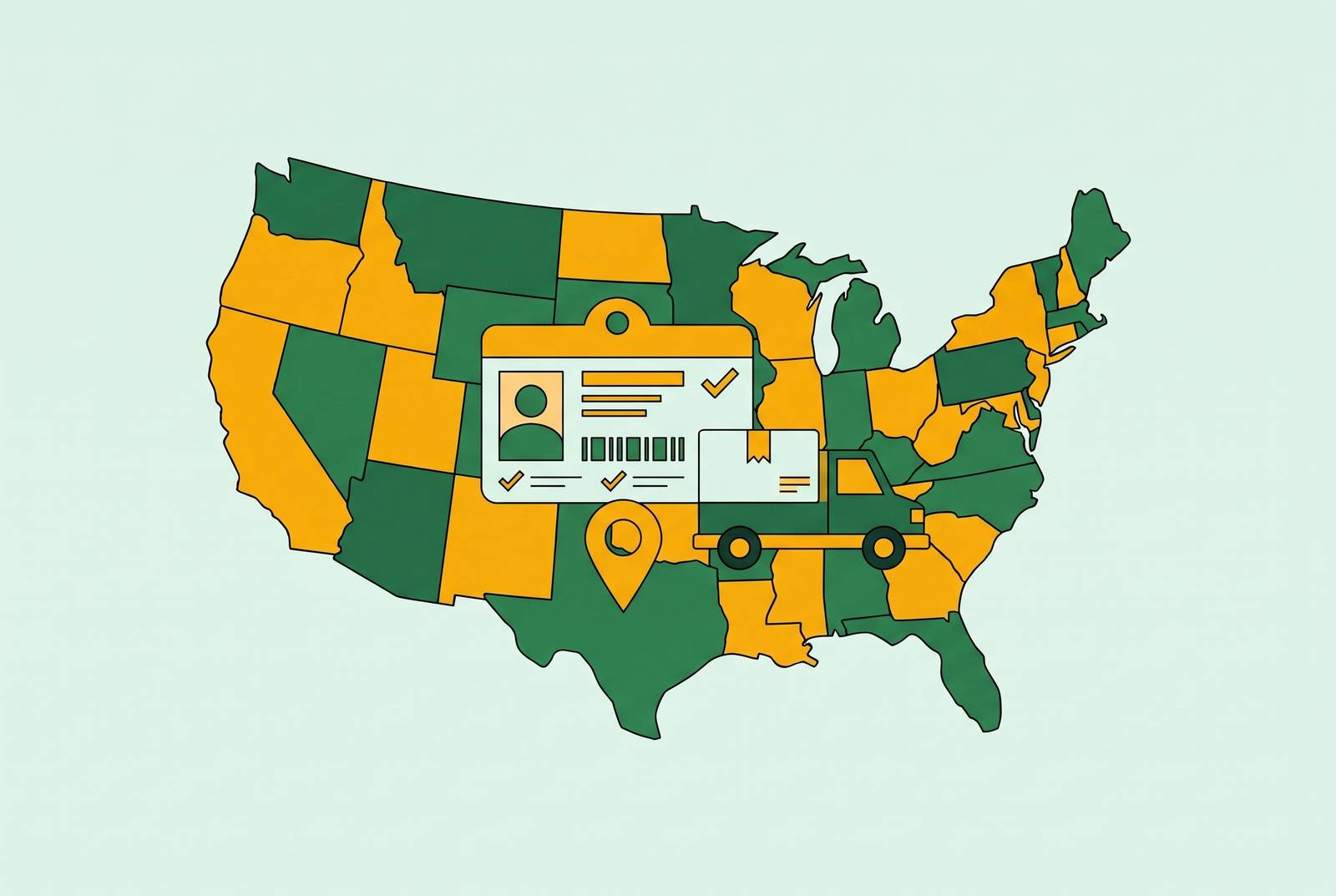
A delivery company expands into a new metro, signs up fifty independent contractors, and runs onboarding exactly the way it ran in the last three markets, so it starts dispatching orders. Three weeks later a county inspector or a platform audit turns up the fact that every one of those fifty drivers needed a municipal business license before the first paid delivery. That failure did not happen because the company was careless. It happened because it treated licensing as one national rulebook instead of a stack of separate ones written by different governments that do not coordinate with each other. The federal government has no general business license for delivery drivers to begin with: the only federal touchpoints for most ICs are an EIN and, for some transportation setups, DOT operating authority. Everything else sits with states, counties, and cities, each of which can require something the jurisdiction next door does not, and that layer decides whether a driver can legally accept an order. A company running drivers in five states cannot build one compliance checklist and copy it five times. It has to build five, and sometimes a dozen within a single state, because a requirement in one county may simply not exist thirty miles away. On top of the geographic patchwork sits a second variable that gets flattened just as often: three distinct delivery business models, each with its own licensing stack, and applying the wrong one wastes effort on the wrong paperwork while leaving the actual exposure uncovered.
What the three delivery business models require at baseline
Before any map of states or counties matters, a delivery operator has to know which of three businesses it is actually running, because a courier moving sealed bags, a company dispatching a fleet of contracted drivers, and a kitchen that cooks the food before someone drives it away face licensing stacks that do not overlap much.
The first model is the independent delivery courier, someone who picks up sealed orders and drives them to a customer without touching what's inside. This is the simplest stack: a business license, commercial auto insurance, and a valid driver's license cover the baseline. No food handler permit applies here, because the driver never preps, repackages, or handles the product directly.
The second model is a delivery company running multiple drivers, whether employed or contracted. Everything from Model 1 still applies, and on top of it the company takes on employer-side obligations: an EIN, payroll systems, workers' compensation coverage, commercial fleet insurance that covers more than one vehicle, and in some states a separate transportation or courier company registration distinct from any individual driver's license.
The third model is the ghost kitchen or meal-prep delivery operation, where the business prepares or packages the food itself before it goes out the door. This one runs two licensing stacks at once, a food business and a logistics business. It requires food handler certification, a health department permit, access to a licensed commercial kitchen, and, for anyone selling across state lines, a possible state food manufacturing registration. This piece is written for delivery drivers and the companies that dispatch them, not for food manufacturers, so this model gets one paragraph and no more: the moment a delivery business starts touching the food instead of just moving it, the licensing math changes.
Two steps apply no matter which model a business fits. Forming an LLC before filing for any license keeps personal assets separate from delivery-related liability, which matters because a serious vehicle accident can produce damages that exceed what a commercial auto policy will pay out. An EIN is the near-universal starting point for all three models: multi-member LLCs, partnerships, and corporations are required to get one, while single-member LLCs and sole proprietors are strongly advised to get one anyway, because most banks, most payroll systems, and most local license applications ask for it before anything else happens. It's free and instant at IRS.gov, which makes it the one piece of this entire process with no cost and no waiting period attached.
The states that require a statewide general business license from every IC
Once a business knows its model, the next question is geographic: does the state itself demand a license before any county or city even enters the picture? Most states leave general business licensing to local governments. A handful do not, and those states sit at the top of the jurisdictional stack, making them the natural starting point for any multi-state compliance map.
Nevada requires every IC, delivery drivers included, to get a Nevada State Business License from the Secretary of State before any county or city license can be issued. Clark County's own guidance states this directly: drivers must get the state license first, full stop, before a county application can even proceed. Delaware runs a parallel system through its Division of Revenue, which requires any contractor conducting business activity in the state to register for and hold a business license, and the requirement applies equally to residents and out-of-state contractors. Delaware's Division of Revenue even maintains a separate Non-Resident Contractors Package specifically for operators based elsewhere, which states directly that doing business inside Delaware's borders triggers the obligation regardless of where the contractor lives.
A statewide license in Nevada or Delaware is a floor, not a ceiling. County and municipal requirements still apply on top of it, and Nevada is the clean illustration: the state license is step one, and the Clark County license is a separate step two. These two states are just what the available primary sources confirm, not an exhaustive national list. A delivery operator expanding into a new state should treat this section as a reason to check that state's own licensing authority directly, not as a substitute for doing so.
County and city licensing layered on top of state requirements: the Nevada/Clark County example
Clark County offers the most fully documented example of how the state and local layers connect, and walking through it step by step models the kind of sequencing a driver or operator should expect to find, in some form, almost anywhere.
The order is fixed: a driver first obtains the Nevada State Business License from the Secretary of State, and only after that can a Clark County business license application proceed. County rules make step one a precondition for step two, not a parallel option. Every delivery driver operating in Clark County needs this county license, regardless of which app or platform dispatches the work. If a driver works both rideshare and delivery, they need two separate business licenses, one for each service type. A rideshare driver who picks up delivery work on the side doesn't get to stretch one license to cover both. Clark County's fee structure is specific: a new delivery driver application costs $45, non-refundable, plus a $25 annual license fee, for a total of $70 to get started, and renewal runs $25 a year, due by October 31 to cover the November-to-October cycle.
The application itself requires selecting the correct NAICS code, and this is where a surprising number of applicants trip over a detail that looks cosmetic but isn't. Delivery drivers select code 492111 (Delivery - Delivery Service). Rideshare and TNC drivers select 485993 instead. Picking the wrong code doesn't just create paperwork friction, it can create a licensing mismatch that an audit or a renewal reveals later, at which point fixing it costs more time than getting it right the first time would have. One more wrinkle for drivers operating through an LLC: a member of the LLC can get a Clark County driver license as an individual, but the license is issued in that person's name, not the LLC's. Clark County will not issue a license to an employee of an LLC, only to a member. So if you are structuring a small fleet operation, you cannot assume the entity itself can hold the license.
State-level delivery-specific regulation: what Texas's 2025 law requires of delivery network companies
General business licensing is only one layer. A growing number of states are writing statutes aimed specifically at delivery platforms, and these laws impose obligations that a standard business license checklist will never flag, because they weren't written with couriers in mind. Texas is the clearest current example.
Texas passed HB 4215, effective September 1, 2025, extending the state's existing transportation network company framework to cover what it calls delivery network companies, defined as entities that use a digital network to arrange delivery of food, beverages, or consumer goods from a restaurant or retail business to a customer. Any covered company has to get a permit from the Texas Department of Licensing and Regulation and pay a fee before operating in the state.
The law sets minimum qualifications for every delivery person working under a covered platform: at least 18 years old, a valid government-issued photo ID, a valid driver's license if the person intends to deliver by motor vehicle, a passed criminal background check run at the local, state, and national level, and a driving record review for anyone delivering by vehicle. It also spells out what disqualifies someone. On the criminal side: a conviction within the preceding seven years for DWI, using a vehicle to commit a felony, felony property damage, fraud, theft, an act of violence, or terrorism, or registration on the national sex offender website. On the driving side: more than four moving violations in the preceding three years, or any conviction for fleeing police, reckless driving, or driving without a valid license.
Companies operating under the law also have to maintain two specific policies: a ban on intoxicating substance use, posted publicly on the website or app with a working complaint mechanism and two years of recordkeeping, and a nondiscrimination policy that every delivery person has to be notified of directly.
HB 4215 runs in both directions, and that is what makes it worth paying close attention to. It loads real compliance work onto the company side, the permit, the background checks, the posted policies, but it also writes IC protections directly into the statute. The company and driver have to agree to IC status in writing, and the law prohibits the company from dictating specific login hours, blocking the driver from working other platforms, assigning a fixed delivery territory, or restricting the driver from holding other jobs. Texas built a law that regulates the platform and locks in contractor independence at the same time, which is a different animal from a licensing requirement that just adds paperwork.
California's ABC test and Proposition 22 as a distinct licensing framework for delivery ICs
California doesn't ask whether a driver has a license first and worry about classification later. It runs the classification analysis first, and licensing becomes evidence inside that larger test. California's ABC test starts from the presumption that every worker is an employee, and the burden sits entirely on the hiring company to prove otherwise across all three prongs of the test.
Part C of that test is where business licensing becomes central, requiring proof that the worker's independent business actually exists and is operating at the time the work happens, not that the worker plans to set one up eventually. The kind of evidence that satisfies Part C includes incorporation, licensure, and a track record of offering services to the public on a routine basis. If a driver only intends to get a business license next month, that doesn't meet this standard. A driver who can't point to an existing, operating business, including a local business license where the municipality requires one, risks failing Part C outright, and failing one prong fails the whole test.
For a delivery company operating in California, this turns business licensing into something closer to a classification safeguard than a compliance box to check. Onboarding a driver without confirming they hold a valid local business license, in a municipality that requires one, can itself become evidence that the relationship lacks the structural independence Part C demands. Proposition 22 and the litigation that followed over its insurance and benefit provisions, including developments at the California Supreme Court, add further layers to how app-based drivers are classified and covered in the state, so any company relying on them should confirm the current state of the law directly. In California, a missing business license isn't just an administrative gap; it's a fact that can be used against the IC relationship itself.
How worker classification tests turn licensing gaps into misclassification liability
Every layer covered so far, federal, state, county, and platform-specific, feeds into the same downstream risk: a licensing gap doesn't just sit there as an unpaid fee. It becomes an argument. Regulators and plaintiffs' attorneys use the same facts that a licensing audit would catch, no business license, no entity formation, no proof of an operating business separate from the platform, as supporting evidence that a worker was never really independent to begin with.
California's ABC test makes that connection explicit through Part C, but you see the same pattern outside California too. Any classification test that asks whether a worker operates a genuine, separate business will look at the same markers: licensure, incorporation, and a pattern of offering services beyond one platform. A driver without a business license, in a jurisdiction that requires one, is a driver with one less piece of evidence to offer in their own defense if classification ever gets challenged. For the company on the other side of that relationship, the exposure compounds. Misclassification findings carry back pay, back taxes, and penalty exposure across every driver swept into the same determination, not just the one driver whose paperwork triggered the audit.
Texas's HB 4215 shows the other direction this is heading: a state writing IC protections directly into statute alongside the compliance burden, so that status itself is defined by law rather than left to a multi-factor test applied after the fact. Nevada and Delaware show the plainer version of the same lesson, that a license obtained in the wrong order, or skipped at the county level because the state license felt sufficient, leaves a documented gap sitting in the file. None of this is a reason to panic over paperwork. It's a reason to treat the business license not as a fee paid to a county office, but as part of the evidentiary record that determines who is liable when something goes wrong on the road.