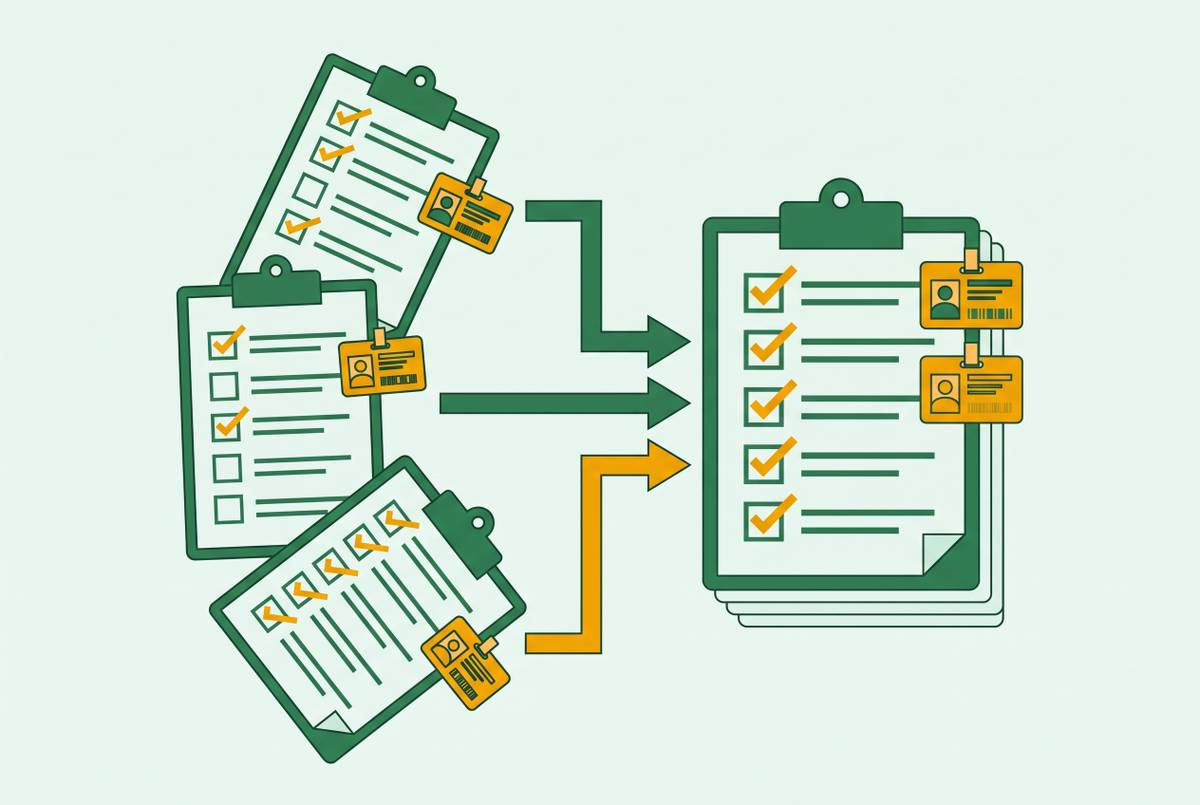
Vehicle Inspection Document Requirements for Last-Mile Contractors
Contractors need clear documentation systems to stay roadside-compliant across state lines.
A last-mile contractor stopped roadside during a delivery window loses more than time at the inspection site. When the vehicle comes off the road, the packages stop moving, and whatever promise the operator made to its shipping partner about delivery windows starts breaking in real time. This article covers the vehicle inspection document requirements last-mile contractors and the operators who manage them need to track, and the argument is straightforward: last-mile contractor operations sit at a denser intersection of federal inspection rules, insurance obligations, and contractor-specific credentialing than almost any other category of commercial driving. A long-haul fleet driver operates under one employer's compliance program and one set of vehicle records. A last-mile contractor carries vehicle-level federal requirements, driver-level daily inspection records, and contractor-status insurance proofs all at once, and no single document covers all three layers. The independent contractor relationship splits responsibility for these documents between the operator's compliance program and the contractor's own obligations, a split that does not exist for W-2 fleet drivers and that creates gaps as soon as a network grows past a handful of vehicles. Operators running contractor networks across state lines add a further wrinkle: a contractor who clears a roadside stop in one state may be placed out of service in another, because state requirements frequently exceed the federal floor.
The in-cab document stack every last-mile contractor must have at the roadside stop
The core in-cab document set for a commercial last-mile vehicle spans vehicle registration, proof of insurance, the annual inspection certificate, fuel tax credentials where applicable, and any permit documentation the load or route requires, and each of these has its own issuing authority and its own expiration clock. Vehicle registration has to be current and has to match the vehicle actually being operated, since a mismatch between the registration and the vehicle is itself a trigger for roadside enforcement action. For contractor-owned vehicles, keeping that registration current is the contractor's job, but operators still have to verify it during onboarding, and they need to keep verifying it afterward, since a document checked once doesn't stay valid forever. Proof of insurance has to show commercial coverage, not a personal auto policy, because a personal policy becomes void the moment a contractor accepts a paid delivery assignment. Major retail and logistics platforms layer their own insurance minimums on top of the legal floor, and certificate of insurance requirements typically call for additional-insured endorsements naming the contracting company directly on the contractor's policy. That certificate has to be current and accessible in the cab at every dispatch, not just filed away from onboarding. The annual inspection certificate belongs in this stack too: FMCSA's Part 396 regulations require every commercial vehicle to undergo a periodic inspection at least once every 12 months, and the original or a copy of that inspection report has to be retained by the motor carrier for 14 months from the report date. Rounding out the stack are fuel tax credentials for contractors crossing state lines, overweight or oversize permits for loads that exceed standard limits, and hazmat shipping papers where applicable cargo requires them. Most urban last-mile contractors will never touch these last three, but any operator running a hybrid network of local and regional routes needs a credentialing system that knows which contractors need which permit layer and which don't.
How the Driver Vehicle Inspection Report works and what the retention rules require
Of everything in the stack, the Driver Vehicle Inspection Report generates the highest daily compliance exposure, because it has to be completed at the end of every driving day and a single missing record counts as a compliance breach rather than a correctable oversight. Under § 396.11 of FMCSA's Part 396, drivers have to complete a daily written post-trip inspection report at the end of each driving day, naming the vehicle and listing any defects or deficiencies that could affect safe operation or cause a mechanical breakdown. The motor carrier or its agent then has to certify that any listed defect has been repaired, or that no immediate repair is necessary, and before the next driver takes the vehicle out, the carrier must repair any defect from the prior DVIR that would be likely to affect safe operation. Some carriers go further and require drivers to keep the previous day's DVIR in the vehicle itself, so a roadside inspector can verify the daily record directly, and incomplete DVIR records in the cab are among the most common violations inspectors find. The retention burden around this document is about to change shape. The February 2026 FMCSA eDVIR Final Rule authorizes digital inspection reports, built on electronic creation, electronic signatures, and cloud-based record-keeping, and that rule change forces every last-mile operator to redesign its pre-trip and post-trip documentation workflow around it. Digital DVIRs close the paper-chain gaps that used to let records disappear between contractor and carrier, but only when the operator's platform is actually configured to capture and retain them in a compliant form; the rule authorizes the fix, it doesn't install it automatically. § 396.11 does not apply to a motor carrier operating only one commercial motor vehicle, which matters for a solo micro-operator but has no bearing on any IC network running at scale.
What the Annual Inspection Requirement Demands from Operators
The annual inspection obligation sits with the motor carrier, not the contractor, so operators running IC networks have to either verify that each contractor's vehicle carries a current, qualifying inspection or arrange for those inspections directly, and they have to keep documentation proving one of those two things happened. FMCSA Part 396 § 396.17 says every commercial vehicle, including each segment of a combination vehicle, has to be inspected at least once every 12 months, covering every item listed in the Minimum Periodic Inspection Standards under Appendix G. It is a hands-on inspection of every safety-critical system, not a walk-around glance at the tires, performed by someone qualified to physically test, measure, and evaluate each component. That qualification requirement is where operators tend to lose the thread. Motor carriers must ensure that the people performing annual inspections meet three separate standards under § 396.19(a): they must understand the inspection criteria in Part 393 and Appendix G and be able to identify defective components, they must be knowledgeable of the methods, procedures, and tools involved, and they must be capable of applying all of that by experience or training. Brake inspections carry their own qualification pathway: the carrier has to confirm the inspector has completed a sponsored apprenticeship or agency-approved training program, or holds a state or Canadian province qualifying certificate, which includes passing the CDL air brake test for brake inspection work specifically, all within a single qualifying pathway rather than as separate boxes to check. The paperwork obligations don't end once the inspection happens. The original or a copy of the periodic inspection report has to be retained by the motor carrier for 14 months from the report date, and proof of that inspection, sticker or report, has to be on the vehicle at all times. An expired or missing annual inspection sticker with no current report on board triggers an automatic out-of-service order at any roadside stop, though CVSA's enforcement authority here is discretionary and a failed in-shop annual inspection doesn't produce an out-of-service order on its own. For an IC network operating at scale, the exposure runs collective rather than individual: a pattern of missing inspection certificates across a contractor roster damages the operator's own CSA safety rating, not just the record of the individual contractor who happened to get stopped.
Roadside Inspection Reports and the 15-Day Rule
A roadside inspection doesn't end when the contractor pulls back onto the road. The carrier carries a binding 15-day obligation to certify that any violations found have been corrected, and failing to close that loop is its own compliance violation, stacked on top of whatever the original inspection found. Under FMCSA Part 396 § 396.9, any driver who receives a roadside inspection report has to deliver it to the employing motor carrier, and in a contractor network that handoff is not automatic the way it would be inside a managed fleet. Operators need a defined process for contractors to submit roadside inspection reports promptly, because the 15-day window starts eroding the moment the inspection ends, whether or not the operator knows about it yet. Within those 15 days, the motor carrier must sign the report certifying that all violations have been corrected and return it to the address printed on the report, then keep a copy on file for 12 months from the inspection date. The difficulty for IC networks compared to captive fleets comes down to dependency: with W-2 drivers, report handoff happens inside a managed operation with built-in oversight, while with independent contractors the carrier depends entirely on the contractor's own awareness and responsiveness. So you need a clear communication protocol, and ideally a platform that tracks submission status instead of relying on a compliance manager's memory. An operator running a network of hundreds of contractors has no practical way to manually track which contractors have received roadside reports and whether the 15-day clock is being met without automated reporting and alerting built into the system. The 15-day rule is concrete and enforceable, most operators already know it exists, and the real gap is that few have built a process that reliably executes it at scale.
Insurance Documentation as Both a Regulatory Floor and a Contractual Ceiling
Insurance documentation operates on a different axis than the inspection paperwork covered above: it's contractual as much as regulatory, and it creates obligations that have to be credentialed and monitored on an ongoing basis rather than checked once. The coverage stack for last-mile IC operations includes commercial auto liability, cargo coverage, general liability, and occupational accident insurance, and personal auto coverage is typically void the moment a contractor activates a delivery app, even before accepting a single paid delivery. Occupational accident insurance works as the contractor-economy substitute for workers' compensation: it covers on-the-job injuries without triggering an employment classification relationship that would undermine the contractor structure itself. Regulatory minimums are only the floor. Major retailers and logistics platforms impose their own insurance requirements on delivery partners that exceed the legal minimum, specifying coverage types, minimum limits, and additional-insured endorsements that name the contracting company directly on the contractor's policy. Certificate of insurance requirements demand proof of coverage before operations begin, so if a contractor's policy lapses mid-engagement, they are technically non-compliant with the platform agreement itself, separate from the underinsurance risk that lapse creates. The deeper problem is timing. A certificate of insurance collected at onboarding proves what coverage existed on that date. It says nothing about whether that coverage is still in force six weeks later when the contractor is actively dispatched on a route. Periodic audits catch lapses after the fact; real-time credential monitoring is the only approach that catches a lapsed policy before a contractor gets dispatched on an uninsured vehicle. Some operators purchase occupational accident and commercial auto coverage in bulk on behalf of their contractor networks, which removes the per-contractor lapse risk entirely and brings a cost advantage from consolidated purchasing volume that individual contractors sourcing their own coverage can't match.
The Document Problem at IC Network Scale
Every requirement covered above, the registration check, the DVIR, the annual inspection certificate, the 15-day certification, the insurance monitoring, is manageable in isolation. A single contractor with a current registration, a daily DVIR habit, and an active insurance policy is not a hard problem to solve. But the arithmetic changes once an operator is running fifty contractors, or five hundred. If a small share of a ten-contractor roster has missing or expired documentation, that's a rounding error that gets caught at the next audit. The same share across a thousand-contractor network is a meaningful number of vehicles that could be pulled off the road on any given day, insurance gaps that could leave the operator exposed on a claim, and CSA score dings that accumulate against the same operating authority regardless of which contractor caused them. The federal rules don't scale their enforcement logic to network size. A missing DVIR is a missing DVIR whether it belongs to the only driver on the books or driver number eight hundred, and CVSA inspectors apply the same standard at the roadside either way. What scales instead is the operator's exposure, because the compliance failures of every contractor in the network roll up into one safety rating, one insurance program, and one set of federal obligations. You can treat credentialing as a series of individual document checks until the network crosses the size where manual tracking runs out of hours in the day. Past that point, the document burden becomes an infrastructure requirement: systems that verify registration and insurance continuously, that capture DVIRs digitally under the 2026 eDVIR framework, and that track the 15-day certification clock automatically across every contractor in the roster. The operators who build that infrastructure before the network outgrows manual tracking are the ones who keep their fleets moving when the inspector shows up unannounced.
Sources
- Inspection, Repair, and Maintenance for Motor Carriers of Passengers - Part 396
- 5.2.2 Vehicle Inspections - fmcsa csa
- U.S. GAO - Department of Transportation, Federal Motor Carrier Safety Administration: Inspection, Repair, and Maintenance; Driver-Vehicle Inspection Report (DVIR)
- View Rule
- [4910-EX-P] DEPARTMENT OF TRANSPORTATION
- eCFR :: 49 CFR Part 396 -- Inspection, Repair, and Maintenance