Commercial Auto Insurance Certificate Collection and Expiration Tracking
Outdated certificates leave delivery operators exposed when contractor policies lapse undetected.

A delivery operator pulls a certificate of insurance from a contractor's file. The document looks clean: correct limits, the company listed as certificate holder, an effective date comfortably in the past. But the policy behind it was cancelled six weeks ago because nobody paid the bill, and nobody told anyone. That gap between the paper and the policy is where delivery operators get hurt, and it starts with a basic misunderstanding about what a COI actually is.
A certificate of insurance documents that coverage existed on the day it was issued. It says nothing about whether that coverage exists today. The COI is a summary, not the policy itself: it cannot be used to process a claim, and it does not guarantee that coverage will respond when something goes wrong. It shows coverage types, limits, effective dates, and named parties, frozen on a single page at the moment it was issued. The ACORD 25, the standard format nearly every COI in the country follows, says this in plain language: the producer or insurer issues the form for informational purposes only, and it confers no rights on the certificate holder. The disclaimer is printed right on the document that operators treat as proof of protection.
If you run a network of independent contractors, that gap matters a lot. When a driver has an accident while making a delivery, the driver's personal auto policy will typically deny the claim, because it excludes commercial delivery use as a matter of standard underwriting. That leaves the contractor's commercial auto coverage as the only policy standing between an accident and an uninsured loss. If that coverage lapsed after the COI was collected, the operator is carrying the exposure with no early warning and a piece of paper that says otherwise.
How coverage lapses without anyone notifying the certificate holder
Insurers cancel policies. Agents update coverage, add vehicles, drop vehicles, change limits. None of that activity updates a certificate that was already issued, and none of it comes with a phone call to the certificate holder. The certificate sits in a folder, accurate on the day it was printed and increasingly fictional with every week that passes.
Five structural weaknesses keep that fiction alive. Collection built on manual email chains is the first: a contractor sends a PDF, the PDF gets filed, and nobody treats that moment as the start of an ongoing obligation. A submitted PDF proves nothing about what the policy looks like the following month. Verification is the second weakness, and it is shallower than it looks. Most manual reviews read only the face of the certificate and miss endorsement gaps. It is unenforceable without a supporting endorsement, such as a CG 20 10 for ongoing operations, actually attached to the policy. A certificate can show every box checked right, and the operator can still have zero standing in a claim.
The third and fourth weaknesses are monitoring and renewal, and they tend to fail together. Under a manual system, someone has to remember to check the expiration date, and the contractor has to decide, unprompted, to send an updated document before the old one expires. Picture a COI collected in January, showing a policy that renews in April. Nothing in a typical manual workflow flags the April date. By midsummer, the driver is still running routes on a certificate that expired three months earlier, and the operator has no idea, because nobody built a system whose job was to notice. The fifth weakness, scattered documentation across inboxes and local folders, becomes a legal problem on top of an operational one: when a claim arrives months later, there is no audit trail showing what was collected, when, or what was done about it.
Two of these failures are specific to how transportation coverage actually works, and they deserve more attention than the generic list suggests. The first involves the additional insured endorsement itself. When a policy renews, the agent issues a new policy term, but if the additional insured endorsement is not reissued to match that new term, the certificate showing the "correct" coverage period is a ghost. It displays dates that look current and binds nothing, because the endorsement that actually grants the operator's rights under the policy never caught up to the renewal. The second involves scheduled-auto coverage. When a VIN is added to or removed from a contractor's policy, that change appears as an endorsement updating the declarations page schedule, not as a change visible on the certificate of insurance itself. A PDF-based review has no way to catch a vehicle swap that happened entirely inside the policy's internal paperwork.
What operators are exposed to when coverage lapses undetected
For IC-based delivery operations, an undetected lapse is layered exposure that can reach the operator directly, and it stacks in at least three ways, far beyond a filing problem fixed with a sternly worded email to the contractor.
The first layer is claim denial. If a contractor's commercial auto policy has lapsed when an incident happens, the operator's own insurer can deny coverage, because the company did not keep up its own vendor insurance requirements. The accident still happened; the paperwork trail makes it the operator's financial problem. The second layer is direct liability. In some states, if you knowingly let an uninsured contractor keep working, you expose the hiring company to personal liability for resulting damages, so a vendor-management failure becomes a company-level legal one. The third layer comes from the carrier market itself. Insurers willing to write hired/non-owned auto for courier companies grow less comfortable carrying personal auto exposure inside contractor networks, so now the market expects contractors to carry commercial auto or while-under-dispatch coverage just to work. Customers are writing higher insurance minimums into contracts as a performance requirement, not an internal nicety. A coverage gap can now trigger a contract breach before it ever triggers a claim.
Misclassification adds a final wrinkle. If a contractor is later found to be misclassified as a 1099 worker, the insurance gap does not stay contained. It compounds with employment law exposure, so the operator can end up facing an uninsured claim and misclassification penalties in the same proceeding.
Requirements for COI collection and verification at onboarding
Collecting a COI correctly at onboarding is necessary, and manual processes are generally capable of doing this one step well. The trouble is that it is one step out of five, and treating it as the whole job is where most compliance programs quietly stop trying.
The five steps run as follows. Collection has to happen before work begins, full stop: no contractor runs a route until a valid COI is on file. You have to actually read the limits, endorsements, and named parties against contract requirements, not just confirm a document arrived. Expiration monitoring means you build alerts that fire ahead of renewal dates, not after them. You have to actively chase updated certificates. You need to keep an organized, timestamped record of every version and every exchange, so you have something to show if a claim appears in a contractor's file six months after the certificate was collected.
Verification itself is more detailed than most manual reviews attempt. The certificate holder name has to match the legal contracting entity exactly; mismatches are a leading cause of denied claims, and they are easy to miss when a company has multiple subsidiaries or recently changed its legal name. Waiver-of-subrogation language needs to be present where the contract requires it. For scheduled-auto policies, the specific vehicles in use need to show up in the description-of-operations field, not just a general commercial auto limit. And coverage requirements should be matched to the type of work a contractor actually does: a while-under-dispatch driver and a contract carrier need different coverage profiles, and a single blanket requirement either over-scrutinizes low-risk roles or, worse, under-scrutinizes high-risk ones.
The fix starts at the structure of onboarding itself. Requirements should be defined by contractor type before onboarding ever begins, so the system knows what "valid" means for each role before a document arrives. COI upload belongs at the same point in the onboarding sequence as W-9 collection, specifically because COI collection is the step most likely to get deferred or skipped under a manual process. And contractors should get instant feedback on what is missing or wrong at the moment of upload, so a correction happens in the same session instead of kicking off a multi-day email chain that ends with a driver running routes on an incomplete file.
The compliance work that begins after the COI is collected
A contractor with valid coverage on Monday can lose it on Tuesday, and a collection-only workflow will never detect that change. This is the pivot the entire argument turns on: collection is table stakes, and the actual compliance work is what happens in the months after the document is filed.
Network size turns this into a math problem fast. Industry practice has settled on renewal reminders that begin well before expiration, with automated alerts going to both the contractor and the compliance team at multiple intervals in the weeks leading up to the renewal date. That cadence is doable by hand for five or ten contractors. It is not doable by hand for a network running into the hundreds, which is exactly the scale at which most delivery operations live. Spreadsheet tracking is the default fallback, and it fails silently the moment a certificate quietly expires between updates.
Periodic audits do not solve this; they just move the discovery date. A monthly or quarterly compliance review might find that a policy lapsed three weeks ago, so the driver has been running routes the entire time the lapse went unnoticed. The interval between audits is, by definition, a window of unmonitored exposure, and for an active delivery network that window never fully closes under a periodic model.
The case that puts this problem beyond argument is the mid-term cancellation. Nothing about that cancellation updates the PDF sitting in the operator's file, and nothing triggers an alert in a spreadsheet, because the spreadsheet only knows about the expiration date it was told to track. The certificate still looks valid. The coverage is gone. No amount of quarterly diligence catches an event that happens on a random Tuesday in month seven of a twelve-month policy.
Closing the gaps PDF collection leaves open
Real-time compliance monitoring works by connecting to where coverage information actually lives, not by collecting static snapshots of it after the fact, which is the architectural difference that resolves mid-term cancellations going undetected.
PDF-based systems, even the automated ones that send expiration reminders, are still working from a document that was accurate the day it was submitted. They can flag an approaching expiration date competently. They cannot detect a mid-term cancellation, and they cannot detect a policy change that happened quietly after the document landed in the file. Source-connected systems take a different approach: they link directly into insurance agency management systems, so when an agent updates a policy, that change propagates automatically to any certificate holder whose vendor's agent sits inside the network. A cancellation, a coverage reduction, a VIN swap, all of it appears immediately in the system, without anyone picking up a phone to call an agent and ask.
AI-powered document review adds a second layer on top of that connection. Modern COI platforms use AI to read every endorsement against a contract's specific coverage requirements at the moment of upload, rather than scanning only the limits printed on the certificate's face. BCS's RiskBot AI, for example, reads COIs and endorsements and shows vendors what is wrong within seconds, with red and green highlights right on the uploaded document. That collapses a correction cycle that used to take weeks of back-and-forth email into a single upload session. The strongest objection to this kind of automation is accuracy: low-quality scans or unusual document formats can trip up document recognition and require a human to step in. Trust only platforms that expose a confidence level on each extracted field and send anything uncertain to a human reviewer.
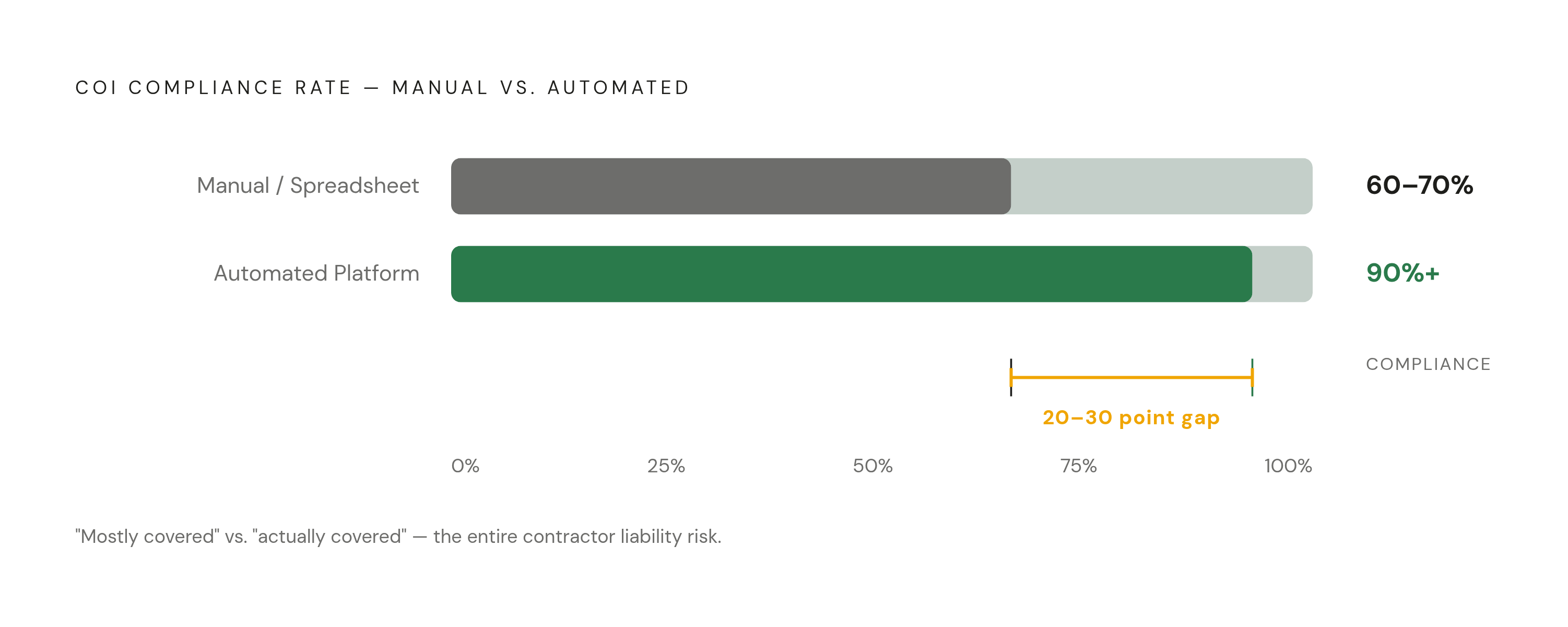
The compliance rate difference between the two approaches is not subtle. Manual, spreadsheet-based COI tracking is typically 60 to 70 percent compliant, but automated platforms push that figure to 90 percent or higher. A 20 to 30 point gap in an insurance compliance rate is not an efficiency improvement: for an operator whose entire liability stack rests on contractor commercial auto policies, the gap between a network that is mostly covered and one that is actually covered is the whole risk picture.
Monitoring and AI review come first, and automated renewal coordination is the third piece. A platform can run a multi-stage reminder cadence across an entire contractor network, and no one has to manually schedule a single follow-up email. Self-service renewal portals complete the loop: contractors upload updated certificates directly and get instant feedback on any gap, which removes the back-office bottleneck that used to sit between a contractor's renewal and the operator's file actually getting updated.
Rigorous COI tracking inside a delivery contractor platform
Put together, rigorous COI tracking for an IC-based delivery network looks less like a filing task and more like a continuous feed. Coverage requirements get defined by contractor role before onboarding starts. Collection happens at the same step as W-9 intake, so it cannot be quietly skipped. Verification has to read endorsements, named-insured language, and vehicle schedules, not just the limits printed on the certificate's face. Monitoring connects to the agency side of the relationship, so a mid-term cancellation or a VIN change becomes visible the day it happens rather than the day someone happens to audit the file. Renewal runs on an automated, multi-stage cadence. And every version, correction, and alert gets logged, so there is a complete record waiting if a claim ever arrives asking what the operator knew and when.
None of this changes what a COI is. It is still a summary document, disclaimed on its own face, proving only that coverage existed on the day it was issued. What changes is how fast an operator finds out when that summary stops matching reality, and if a delivery network's entire insurance stack depends on a contractor's commercial auto policy staying active, that speed is all that stands between a clean file and an uninsured claim nobody saw coming.