Commercial Auto Insurance Gaps in Personal Vehicle Delivery Operations
Personal auto policies exclude delivery work, leaving drivers uninsured during shifts.
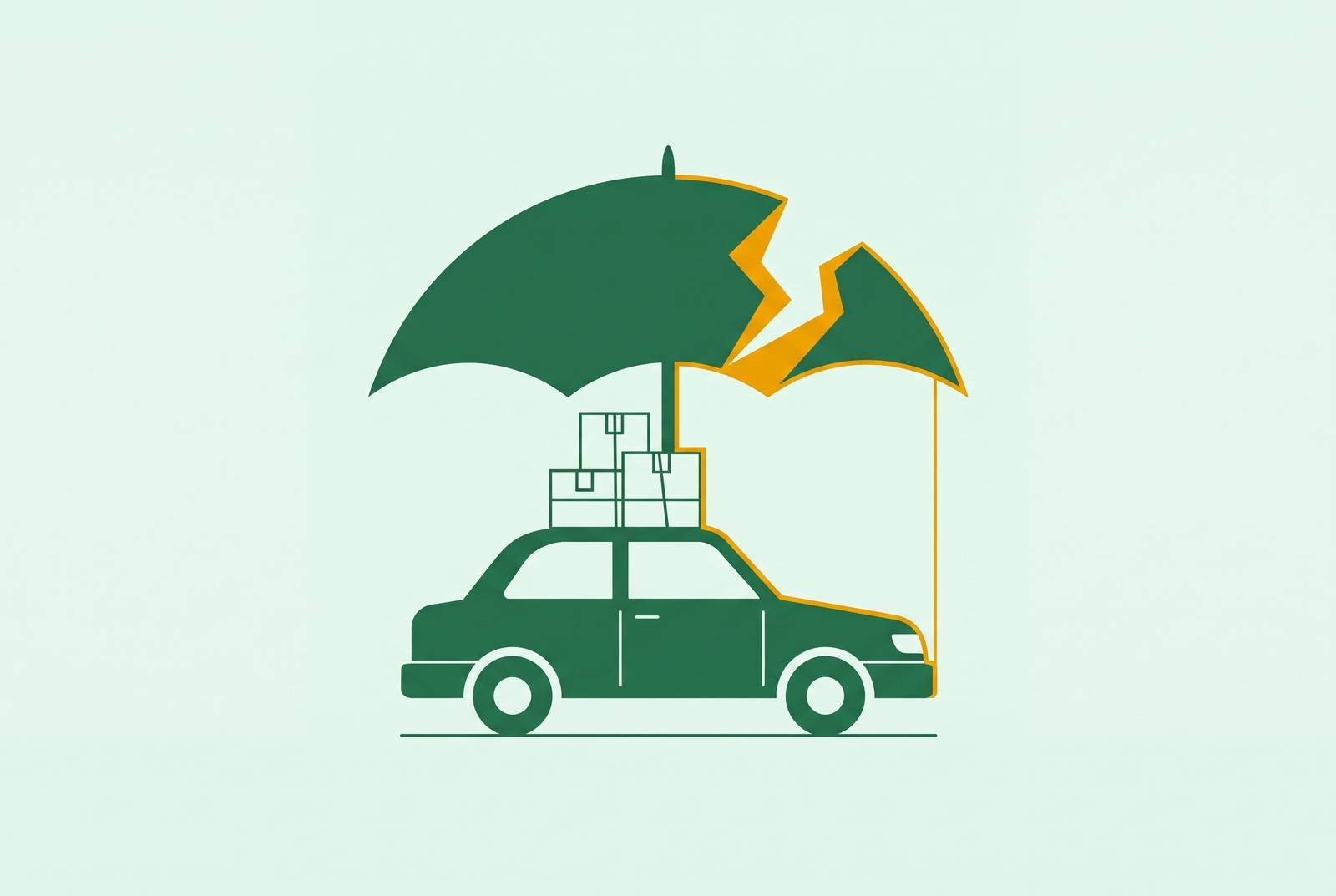
Personal auto insurance stops covering a driver the moment that driver starts working for pay, and the exclusion is written into the policy on day one, not discovered later as a loophole. This piece maps where the coverage actually breaks across a delivery shift, why the common fixes (a rideshare endorsement, a verbal assurance from an agent) don't close the gap they appear to close, and what a denied claim costs when the gap finds someone. It also covers the stack of products that does close it, and what operators running contractor networks need to build so the gap doesn't become their problem by proxy.
Why personal auto policies do not cover delivery work
A personal auto policy is underwritten on a bet: that the car gets driven to work, to the grocery store, to a kid's soccer practice, and back into the garage at night. The second a driver accepts a paid delivery order, that bet is void: the exclusion for commercial use isn't a gray area subject to interpretation, but a specific clause most insurers write directly into the contract.
The exclusion doesn't wait for an accident, or even for a completed delivery, to activate. The trigger is commercial activity itself. A driver sitting at a stoplight with an insulated delivery bag on the passenger seat, no order yet accepted, has already stepped outside what the policy covers in the eyes of an insurer reconstructing the timeline after a claim. Some carriers draw the line at logging into the app at all, regardless of whether an order ever comes through. The policy was priced for a driver who runs errands. It was not priced for a driver who makes 15 stops in an afternoon for a fee.
That distinction is exposed when a claim gets filed, often at the worst possible time. Investigators look for GPS history showing a pattern of short, frequent stops, for delivery bags or hot boxes in the vehicle, for app login records that place the driver on shift at the time of the crash. A single delivery-linked claim can end in denial, retroactive cancellation of the policy, and a non-disclosure mark that makes every future policy cost the driver more to buy.
The three-period framework and the worst gap
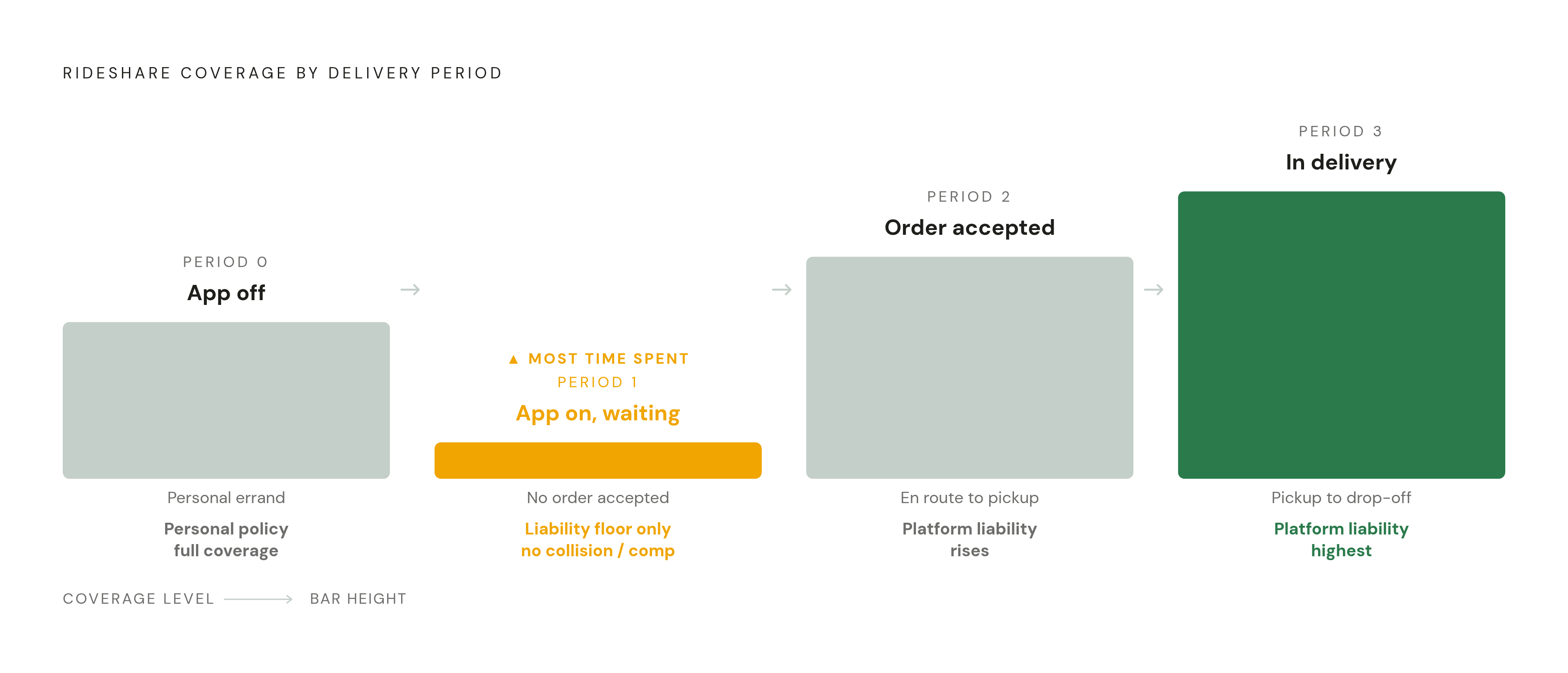
The industry describes a delivery shift in three periods, and the framework is useful precisely because it shows that the coverage gap isn't a flat, uniform absence. It's concentrated in the period where ambiguity is highest.
Period 0 is the app off, the driver running a personal errand. The personal policy applies exactly as written, and there's no gap to discuss.
Period 1 begins the moment the app goes on and ends when a request is accepted. The personal insurer has already excluded this activity, and the platform typically provides only a bare floor of liability coverage, often capped well below what a serious crash actually costs, with no collision or comprehensive protection on the vehicle itself. A driver who gets rear-ended while idling in Period 1, waiting for an order that never comes, can be left with damage to a vehicle that neither the personal insurer nor the platform will pay to fix.
Period 2 starts once an order is accepted and runs through the trip to pick it up; Period 3 covers the drive from pickup to drop-off. Platform liability coverage goes up a lot across both periods, often reaching limits far higher than what's available in Period 1. The deductibles attached to that coverage can run high enough to consume most of a driver's earnings for the week. "Covered" in Periods 2 and 3 doesn't mean "made whole. The driver with the least protection is the one who has spent the most cumulative time exposed: waiting.
Why rideshare endorsements do not automatically cover delivery
The most common fix drivers reach for, a rideshare endorsement, is also the most commonly misunderstood one. The two endorsements are not interchangeable just because both involve an app and a phone mounted to the dashboard.
Some policies state outright that they exclude "delivery of goods" in the same paragraph that confirms coverage for "transportation of passengers." The mistake isn't carelessness. The language simply reads as broader protection than it provides.
Ask the insurer in writing whether the policy covers delivery of goods for hire, and whether it covers Period 1 by name. Asking whether a policy "covers gig work" or "covers rideshare" invites a yes that answers a different question than the one that matters.
What a denied claim costs a delivery contractor
The financial damage from an uninsured delivery accident rarely stays contained to the cost of the collision. Repair costs alone from a single incident can erase weeks or months of delivery income, since the vehicle is both the tool of the job and the asset now sitting in a body shop.
The sequence runs the same way nearly every time. The driver loses the claim and the premium already paid, in the same motion. Most delivery drivers don't learn their policy excluded the work until the accident has already happened. The accident itself is usually the first notice anyone gets that the coverage was never there.
The coverage options that close the gap
Three tiers of coverage exist to close this gap, arranged on a spectrum from cheap-and-limited to expensive-and-complete. Picking the wrong tier leaves a driver either exposed in the exact way described above, or paying commercial-grade premiums for a Saturday side hustle that never needed them.
Tier 1 is a delivery or business-use endorsement layered onto an existing personal policy. The monthly cost is low, often comparable to the pay from one or two deliveries, which makes it the natural first stop for anyone running delivery part-time or occasionally. The endorsement is only worth buying if it names Period 1 and names delivery of goods specifically, since an endorsement that covers only rideshare passenger transport solves nothing for a DoorDash or Instacart shift.
Tier 2 is a standalone hybrid or gig-specific policy, built from the ground up to bridge all three periods rather than patching a personal policy with an add-on. These policies suit drivers who work across several platforms at once, or anyone for whom delivery income is a substantial share of total earnings. The premium costs more than an endorsement but less than a full commercial policy.
Tier 3 is a commercial auto policy, and for some operators it isn't optional. Federal law under 49 CFR Part 387 requires it for vehicles operating under FMCSA authority, and freight brokers frequently require liability limits above the federal minimum as a condition of the contract regardless of what the law technically demands. Annual cost for a van running this kind of coverage runs into the thousands of dollars and swings significantly by state and by vehicle class, but Tier 3 is the appropriate choice for full-time operators and for fleets, where the completeness of the protection outweighs the premium.
Whichever tier a driver lands on, the answer has to come from the insurer in writing. A verbal assurance from an agent is not the document a claims adjuster reads after an accident.
Why last-mile delivery insurance is a stack
Commercial auto coverage handles the vehicle and third-party liability from an accident, and that's the limit of what it handles. It says nothing about damaged cargo, nothing about an injured driver, nothing about a customer who slips on a wet porch during a hand-off. An operator who treats commercial auto as the whole insurance program is covered on one front and exposed on three others simultaneously.
The full stack for a last-mile delivery operation has several layers. Commercial auto liability covers third-party bodily injury and property damage when the vehicle causes it. Physical damage coverage is a separate line item that covers the operator's own vehicles, because liability-only policies don't pay to fix the operator's own truck. General liability covers incidents that have nothing to do with the vehicle at all, a driver injuring someone at the door or damaging property during delivery. Occupational accident insurance, covered in detail below, protects the contractor's own body when none of the above does.
The floor the government sets is lower than the floor the market actually demands, and an operator building a program around the federal minimum alone is building to a standard the industry has already moved past.
Occupational accident insurance and the workers' comp gap for contractors
Workers' compensation is built for employees, and extending it to independent contractors risks undermining the independent-contractor classification the entire relationship depends on. Occupational accident insurance fills the same need: it covers medical costs and lost income from an on-the-job injury, but it doesn't create the employment relationship that workers' comp implies.
OAI has its own period-gap problem. Platform OAI policies typically pay out for injuries during an active delivery, but they pay nothing for an injury that happens between deliveries, between apps, or once the driver has logged off for the day. The same logic that leaves Period 1 exposed on the auto side leaves a contractor exposed on the injury side whenever the clock isn't actively running on a job.
Some insurers have begun selling OAI on a pay-as-you-go basis, tied to active dispatch periods, so an operator pays premium only for the hours a contractor is actually working rather than for every hour that contractor is technically available. That structure lines the cost of the coverage up with the actual exposure, instead of charging a flat rate for risk that isn't being taken most of the time.
California set the legal baseline here. Prop 22 requires app-based transportation and delivery companies to carry OAI for their contractors, and the California Supreme Court upheld Prop 22's constitutionality in July 2024, in Castellanos v. State of California. That ruling makes OAI a legally stable requirement in California's gig delivery sector, and the structure is a reasonable template for what other states adopt next, rather than a quirk unique to one state's ballot initiative.
How misclassification risk intersects with insurance decisions
The insurance an operator carries for its contractors doesn't stay in a financial silo. It functions as evidence. Regulators and plaintiffs' attorneys read the choice of coverage, OAI versus workers' comp, commercial policy versus personal endorsement, as one of several signals that show whether a contractor is genuinely independent or functionally an employee working as a contractor in label only. Get the insurance choice wrong, and it can accelerate a misclassification finding unrelated to insurance.
The federal picture here has been unstable enough that it can't anchor a compliance strategy on its own. By August and September of 2025, the Trump DOL's regulatory agenda signaled a new rule was in the works, but the actual proposed rule wasn't published until February 2026. Because of that gap between signal and publication, state law carries the sharper near-term risk for operators, and California's ABC test under AB5 stays in full force no matter what Washington finalizes.
The documentation behind the contract language is what survives an audit or a lawsuit: settlement statements, itemized business-to-business pay records, and concrete evidence that a contractor actually controls how the work gets done. A boilerplate independent-contractor agreement proves nothing on its own. The insurance structure an operator builds is one more data point feeding into that same documentation trail, for better or worse.
Building a compliant, insured contractor network at scale
Closing this gap for one driver is a matter of picking the right tier of policy. Closing it across a network of hundreds of contractors is an infrastructure problem: a single lapsed policy on one contractor creates the same liability exposure as having no insurance requirement.
Onboarding is the first checkpoint, and it has to verify insurance certificates, not just file them. A system that collects a certificate at signup and never looks at it again has only confirmed that coverage existed on one specific day. If you build risk questionnaires and tax classification checks into onboarding, you catch misclassification exposure before it becomes a pattern across the whole network, instead of after a single bad case draws regulatory attention.
Coverage verified once isn't coverage verified continuously. A certificate collected at onboarding is a snapshot, and a policy can lapse the next month without anyone at the operator noticing until a claim exposes it. Real-time monitoring that flags a lapse, an expiration, or a change in a contractor's coverage the moment it happens is the only approach that scales past a small roster of drivers.
Bulk purchasing also solves a monitoring problem. Operators who consolidate occupational accident and commercial auto coverage for their whole contractor network access rates no individual contractor could get shopping alone, and centralizing the policy means lapse risk lives in one place instead of being scattered across hundreds of separate contracts.
Payment speed turns out to be a compliance lever as much as a retention one. If you pay contractors quickly, through instant debit or same-day ACH, they're more likely to keep their own credentials and coverage current, because slow pay creates the cash-flow pressure that makes a renewal premium feel like the easiest bill to skip. So if an operator pays slowly, it is, indirectly, training its own contractor base to let coverage lapse.
Put together, onboarding verification, real-time monitoring, bulk purchasing, and fast payment form a system that treats insurance as infrastructure. An operator running that system is running a network where coverage functions as a reason good contractors choose to stay.