Instant Pay via Debit Card for Delivery Contractor Settlement
Instant payouts to debit cards win driver loyalty where weekly deposits lose platform share.
A driver finishes the last run of a shift, logs out, and immediately owes money. Gas tank near empty, a toll charge from the last bridge crossing, maybe a tire that needs air before tomorrow's shift. None of that waits for a weekly deposit. Delivery contractors often run two, three, even four apps at once, so every payout cycle turns into a live comparison against what the other apps are doing that same week. If a platform settles in minutes, it wins that comparison before the driver even opens the competing app. This is an operational fact that decides which platform gets the next shift, and over months, which platform keeps its best drivers while another cycles through replacements that are slower, less reliable, and more likely to make the kind of mistakes that generate customer complaints. A platform paying slightly less per delivery but settling instantly will out-recruit and out-retain a platform paying more on a weekly ACH cycle, because a driver without fuel money cannot run tomorrow's route no matter how good next Friday's deposit looks on paper.
What push-to-card settlement actually is and how it moves money
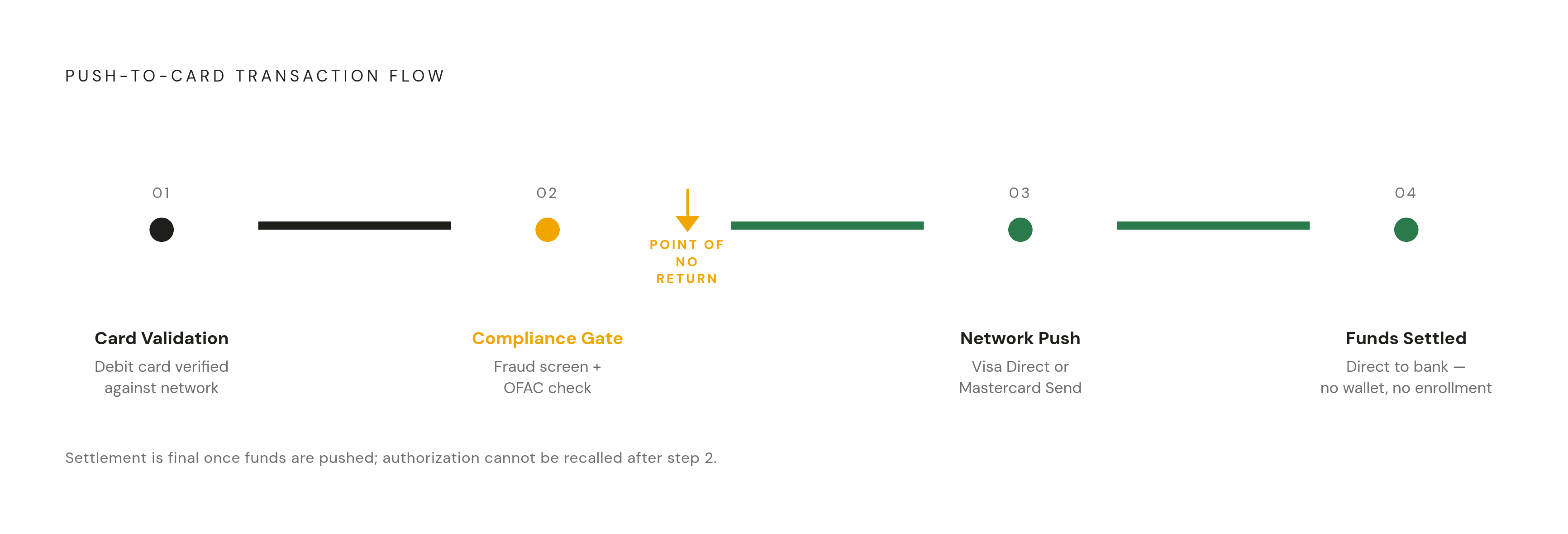
Push-to-card is not ACH with a faster clock. ACH pulls funds from an originating account through a clearing house on a batch schedule. Push-to-card pushes money outward, directly to a card network, skipping the clearing-house queue. The mechanics run in four steps. First, the debit card number gets validated against the card network to confirm it's active and eligible to receive a push transaction. Second, the transaction runs through fraud screening before anything is authorized. Third, the push instruction travels through Visa Direct or Mastercard Send to the card's issuing bank. Fourth, funds land directly in the driver's linked bank account, no wallet to set up, no extra enrollment step, no transfer friction between receiving the money and being able to spend it.
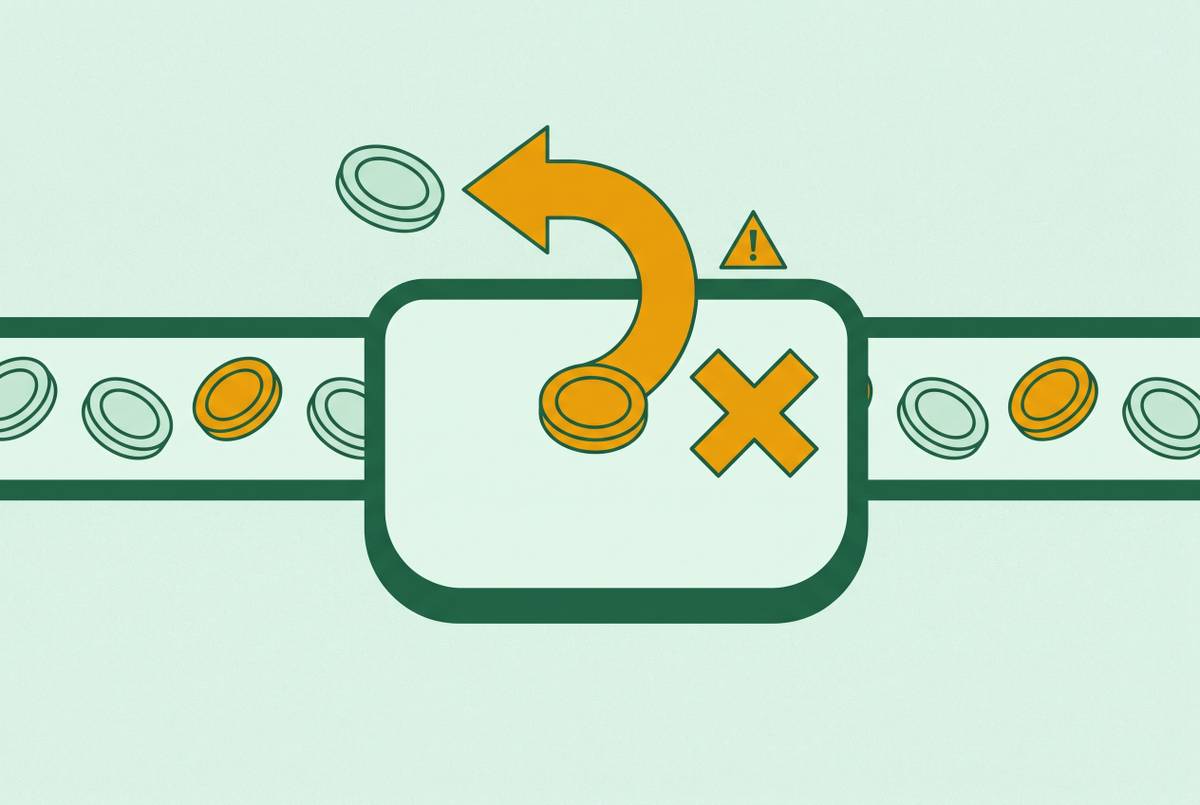
Visa Direct and Mastercard Send handle most instant debit card payouts at the volume delivery platforms operate at, and both work the same way: push funds straight to a debit card, settling in minutes. The catch, and it matters more than it sounds like it should, is that settlement is final. Once the funds are pushed, there's no recall, no return window, no undo button. That finality is why pre-send validation and OFAC screening can't be treated as optional add-ons bolted onto the payment flow. They're the gate that has to close before the money moves, because once it moves, it's gone. What a driver actually experiences on the other end still depends on variables outside the platform's control: issuing bank processing windows that can introduce delay outside business hours, card type (prepaid debit cards sometimes post slower than standard ones), and whatever fraud screening the issuing bank itself runs on incoming pushes.
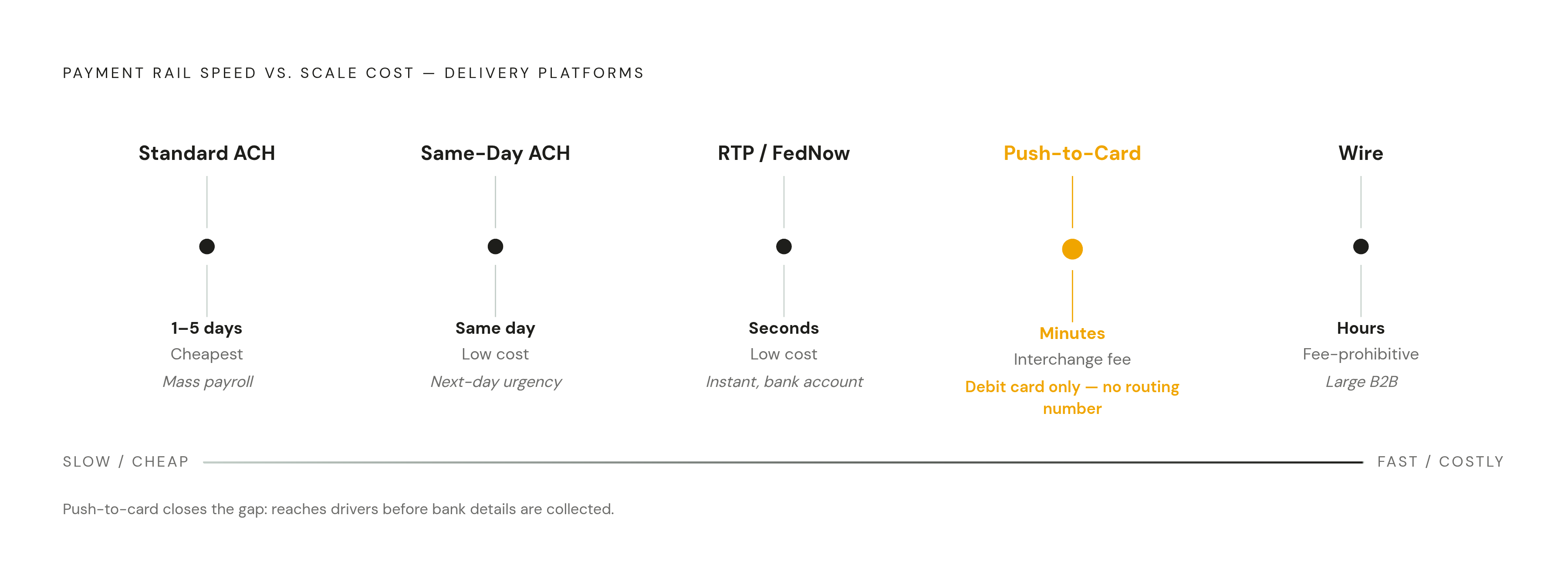
Where push-to-card fits against ACH, Same-Day ACH, RTP, FedNow, and wire for high-volume contractor disbursements
Picking the wrong settlement rail at volume isn't a minor inconvenience. It creates a gap between what contractors expect and what actually lands in their account, and drivers read that gap as a platform that can't be trusted to pay on time. Standard ACH settles over one to five business days through batch processing. Same-Day ACH speeds that up but still runs in batches tied to business days, so it never delivers the real-time availability drivers are comparing platforms on. Wire transfers settle faster than either, but wire fees that make sense for one large one-off payment turn into a real cost problem once they're multiplied across thousands of monthly contractor payouts.
RTP and FedNow settle directly into bank accounts in seconds, any time, any day of the year, with no percentage-based interchange fee attached, which makes them the cheapest option at high volume for any driver who has an eligible deposit account on file. Push-to-card's advantage is one RTP and FedNow can't reach: it pays out to anyone holding an eligible Visa or Mastercard debit card without needing full bank routing and account numbers up front, and that matters enormously for onboarding-sensitive networks where asking for bank details too early causes drivers to drop out of signup.
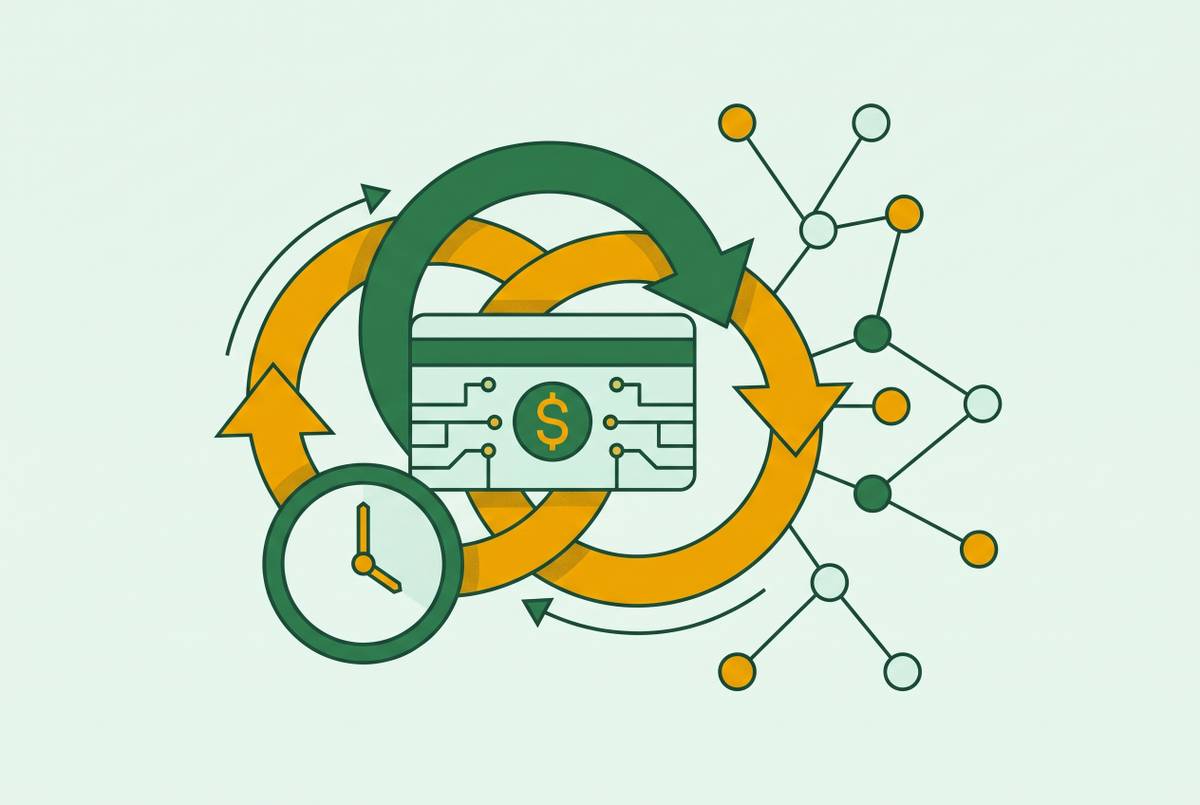
None of these rails is the single right answer for every contractor network. The decision looks more like a matrix than a ranking: ACH for low-urgency, low-cost bulk settlement; RTP or FedNow for drivers with eligible deposit accounts who want speed without a card fee; push-to-card for drivers who onboard with just a debit card and need money moving before they've handed over full bank details; wire reserved for the rare large one-off payment where speed matters more than fee efficiency. Multi-rail orchestration lets the system pick the right rail per transaction at runtime based on the payee's profile, so it closes the coverage gaps that come from betting the whole disbursement model on one rail. Push-to-card does its clearest work in three situations: gig payouts right after a completed shift, where the driver needs same-session access to cover immediate costs; cross-border contractor payments in markets where card network infrastructure supports real-time push; and onboarding flows where collecting a card number is far less friction than collecting full bank account details.
How Instant Pay Converts From a Cost Center Into a Revenue Line
The obvious objection is that instant pay costs more per transaction than ACH. That's true, and it's also the wrong frame. Push-to-card does carry a higher per-transaction fee than ACH, but platforms don't have to eat that cost as a blanket expense. They can structure it as a choice. Standard payouts stay free and run on the normal batch schedule, but if a driver wants money the moment a shift ends, they pay a small per-transfer fee for that option. So this single design decision turns disbursement infrastructure from a cost line into a revenue line.
DoorDash's Fast Pay charges a flat per-transfer fee for drivers who want same-day access to a linked debit card. Uber's Instant Pay lets eligible drivers cash out up to six times a day to a linked debit card. Both companies treat the speed premium as a product feature worth charging for, not a subsidy they absorb quietly in the background. A platform can run the same play: absorb network costs on standard payouts, charge only for the drivers who want true real-time delivery, and keep the base offering free so it never becomes a barrier to signing up.
The retention math backs this up even before the fee revenue is counted. Replacing an experienced driver costs more than recruiting, screening, and onboarding alone would suggest, because a new driver is slower, makes more mistakes, and takes weeks to reach the productivity of the driver who just left. A modest instant-pay fee is cheap compared to that churn cost. The fee structure is a design choice, not a fixed liability a platform has to accept, and the operators who treat it that way come out ahead of the ones still thinking of instant pay as a feature they're being forced to subsidize.
Why instant pay loses its retention value without a fast onboarding pipeline behind it
Instant pay at the end of a shift means nothing to a driver who can't get through onboarding fast enough to run a first route. Onboarding completion, meaning paperwork filed, training watched, app installed, isn't the metric that predicts fleet performance; time-to-productivity is: the number of days between hire and that driver running independent routes without supervision.
Those days get lost in hand-offs nobody notices until they add them up. Paper forms get re-keyed into a system by hand. Background checks get kicked off serially. Someone checks insurance by hand, matching a document against a list. In a high-churn fleet, where a large share of the driver pool turns over every year, this is a permanent onboarding factory running at full capacity, and every delay built into that factory gets multiplied by every driver who passes through it. The fix is structural: collect everything digitally once, run credentialing checks in parallel instead of serially, and make status visible to whoever owns onboarding at every stage, so a driver reaches payout-ready status as fast as they reach their first route. The screening and payment systems aren't two separate processes bolted together. Onboarding should collect card or bank details and payment preferences at intake, before the first disbursement ever fires, so a driver doesn't finish their first shift only to discover payment setup is still pending.
Credentialing and compliance as the upstream gate that determines pay speed
No driver gets paid, instantly or otherwise, until the platform has confirmed the credentials that make them eligible to work: license, background check, vehicle documentation, insurance. Under the FCRA, criminal background checks typically use a seven-year lookback for non-conviction records, but convictions carry no federal time limit, so they can be reported indefinitely, though some states cap conviction reporting at seven years. Most operations run automated systems that flag concerns before a human ever reviews the file, and the biggest time sink is running the checks one after another instead of all in parallel.
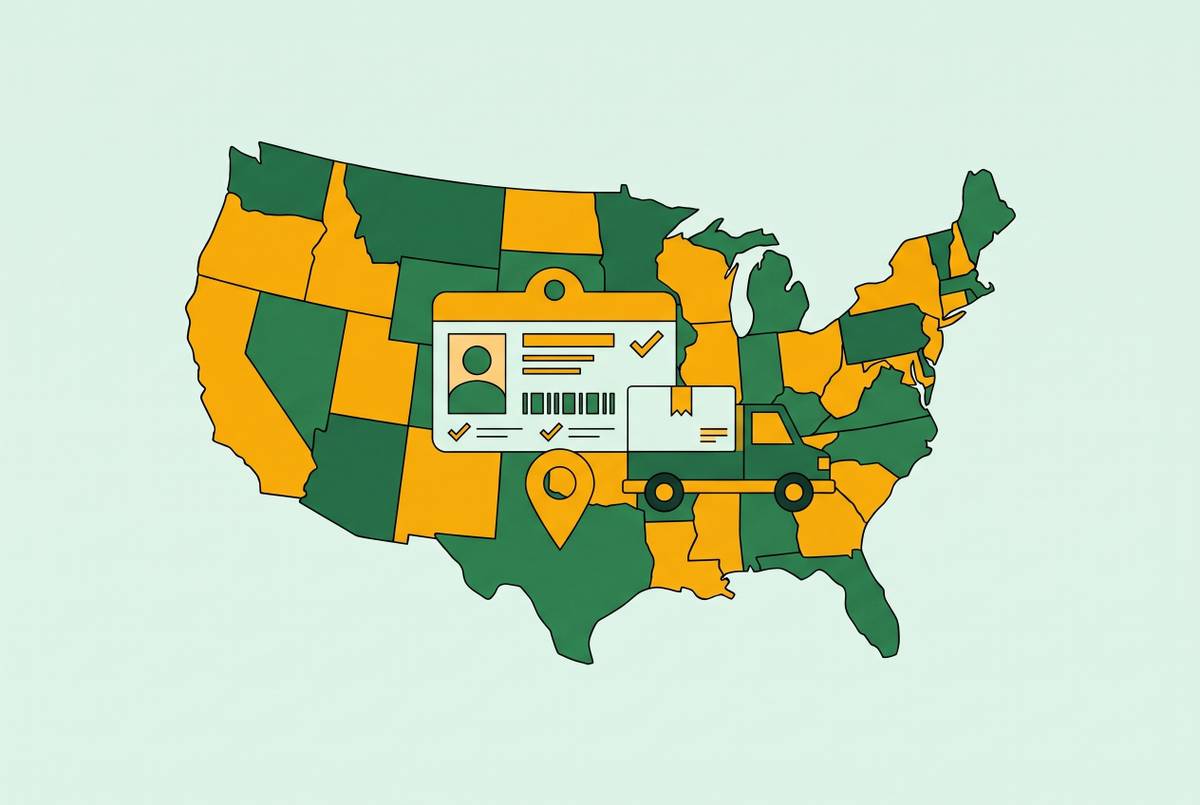
The regulatory ground under all of this keeps moving. The DOL's Final Rule leaned on a six-factor economic realities test, and in February 2026 the Department's Wage and Hour Division issued a new Notice of Proposed Rulemaking to revise the standard used to classify workers under the FLSA again. So operators end up making payment-structure decisions in a legal gray zone, and the structure itself carries regulatory weight there. California still runs the strict ABC test under AB5, and the IRS is ramping up audits, sharing more data across agencies as it does. A contractor network that operates across several states faces a different compliance bar in each one, and once the driver count passes a modest threshold, you can't track that by hand anymore. Because push-to-card settlement is final the instant it fires, the compliance check has to happen before the money moves, not after. Pre-send validation, idempotency handling, and OFAC screening are the infrastructure that makes instant settlement safe to run.
Insurance coverage as the missing layer that makes instant pay meaningful for drivers and operators alike
Fast pay solves a cash-flow problem. An uninsured driver's financial exposure becomes the operator's liability exposure too, in the form of lawsuits, denied claims, and regulatory penalties that land squarely on the platform.
The gap starts with a detail most drivers never read on their personal auto policy: nearly every personal policy carries a business-use exclusion, and it activates the moment a driver logs into a delivery app, not the moment an accident happens. That gap sits invisible until a claim gets filed and the personal insurer denies it. Covering a last-mile delivery fleet properly means stacking several kinds of coverage, not buying one policy and calling it done: commercial auto liability, cargo coverage, general liability, and occupational accident insurance for contractors who, because they're classified as independent rather than employees, aren't eligible for workers' compensation. Worker misclassification compounds this risk directly: a driver treated as a contractor but later ruled an employee can trigger denied claims, regulatory penalties, and litigation that's expensive regardless of outcome. Specialized insurers who review contracts and assess structural risk before writing policies turn insurance selection into a compliance decision as much as a cost decision, and platforms that build this into the onboarding and payment pipeline are offering drivers an actual safety net underneath the paycheck, something ACH speed alone never could.
A Fully Integrated Disbursement Model at Scale
An operator who bolts instant pay onto a slow onboarding pipeline, a manual compliance process, and insurance sourced separately by each driver captures only a sliver of what instant pay is capable of delivering. The integrated version runs all of it from one platform, in sequence: digital onboarding collects card or bank details alongside credentials and insurance documentation at the same intake step; credentialing checks run in parallel instead of one after another; the first payout fires automatically the moment a route is completed, with compliance status confirmed in real time instead of checked on some periodic audit cycle weeks later.
Multi-rail architecture routes each payment based on the driver's actual profile: push-to-card for drivers who enroll with a debit card, RTP or FedNow for drivers with an eligible deposit account on file, so no contractor falls into a coverage gap because the platform only built for one rail. Real-time compliance monitoring, rather than periodic audits, is what lets a large contractor network stay in good standing without adding headcount to the back office: license expirations, insurance lapses, and credential gaps surface before they turn into liability, not after a claim has already been filed. The business case closes when retention, compliance, and pay speed get measured as one system. A driver who onboards in days, carries the right coverage, and gets paid the moment a shift ends is a driver who stays on the platform. And a driver who stays is the unit economics that makes last-mile delivery work at scale.