Same-Day Contractor Readiness Checklists for Last-Mile Logistics Operations at Peak Volume
Prepare contractors before peak volume hits to avoid activation delays.

Same-day contractor readiness in last-mile logistics depends on completing classification, credentialing, insurance, payment setup, and monitoring before peak demand arrives. To compress onboarding without adding administrative staff, operators need one flow that validates documents, verifies payment details, and establishes current coverage. The fastest activation is the release of a contractor whose readiness is already known.
Why same-day contractor activation is an operational discipline, not a staffing scramble
A contractor can be available and still be impossible to dispatch. A missing tax form, an expired insurance certificate, or an unverified payment account can leave an operations manager with willing drivers and unusable capacity. Meanwhile, inventory accuracy, dispatch intelligence, service-level segmentation, staging control, and automated exceptions all depend on having contractors ready to execute the plan. A customer promise does not clear a driver’s paperwork.
The operational distinction is between recruiting capacity and activating it. Recruiting puts people in the pool, while readiness establishes which people can go out under the applicable rules, with valid credentials, suitable coverage, and a working pay path. Peak volume exposes any separation between those two states. The preparation therefore belongs before the surge, when unresolved requirements can be addressed without consuming the dispatch window.
How IC classification rules set the boundaries every readiness checklist must work within
Classification determines what an activation workflow must prove. An independent contractor agreement does not settle every question about the relationship. The workflow must account for the rules where the contractor operates and the way the business engages them.
The U.S. Department of Labor proposed replacing its 2024 classification rule on February 26, 2026. The department had separately announced in May 2025, through Field Assistance Bulletin 2025-1, that it was no longer applying the 2024 rule in its own enforcement investigations. However, that rule still governs private lawsuits under the Fair Labor Standards Act. The replacement remains proposed, with its public comment period closed April 28, 2026.
State requirements add a separate activation constraint. California, Massachusetts, and New Jersey apply the ABC test, which presumes employment unless the business proves otherwise on all three prongs. Documentation is therefore part of the classification gate. Kansas HB 2602 permits company contributions to portable benefits accounts without treating those contributions as evidence of employment, a provision operators in that state should incorporate into benefits and onboarding design. Washington HB 2471 gives PERC contingent enforcement powers over private-sector labor disputes only under specified triggers involving NLRB jurisdiction or federal preemption.
Tax records also affect the cost of a classification failure. IRC Section 3509(a), where required Form 1099s were filed, produces an aggregate effective tax rate of roughly 10.68% on wages up to the Social Security wage base, with a lower rate above it. Section 3509(b), where those forms were not filed, roughly doubles both rates. Separately, the 1099-NEC reporting threshold increased for payments made in 2026, but income below it remains taxable to the contractor. These distinctions make correct documentation the next operational dependency.
How to speed up onboarding delivery drivers without hiring more admin staff
Document collection is where same-day activation most often breaks down. Emailing W-9 forms, copying bank details into spreadsheets, and tracking licenses and insurance in disconnected systems make each contractor another round of manual follow-up. Payment confirmation can then wait days for an ACH batch. The queue grows faster than the ready pool. Operators using these processes also risk losing contractors to companies that clear documentation in minutes and pay instantly.
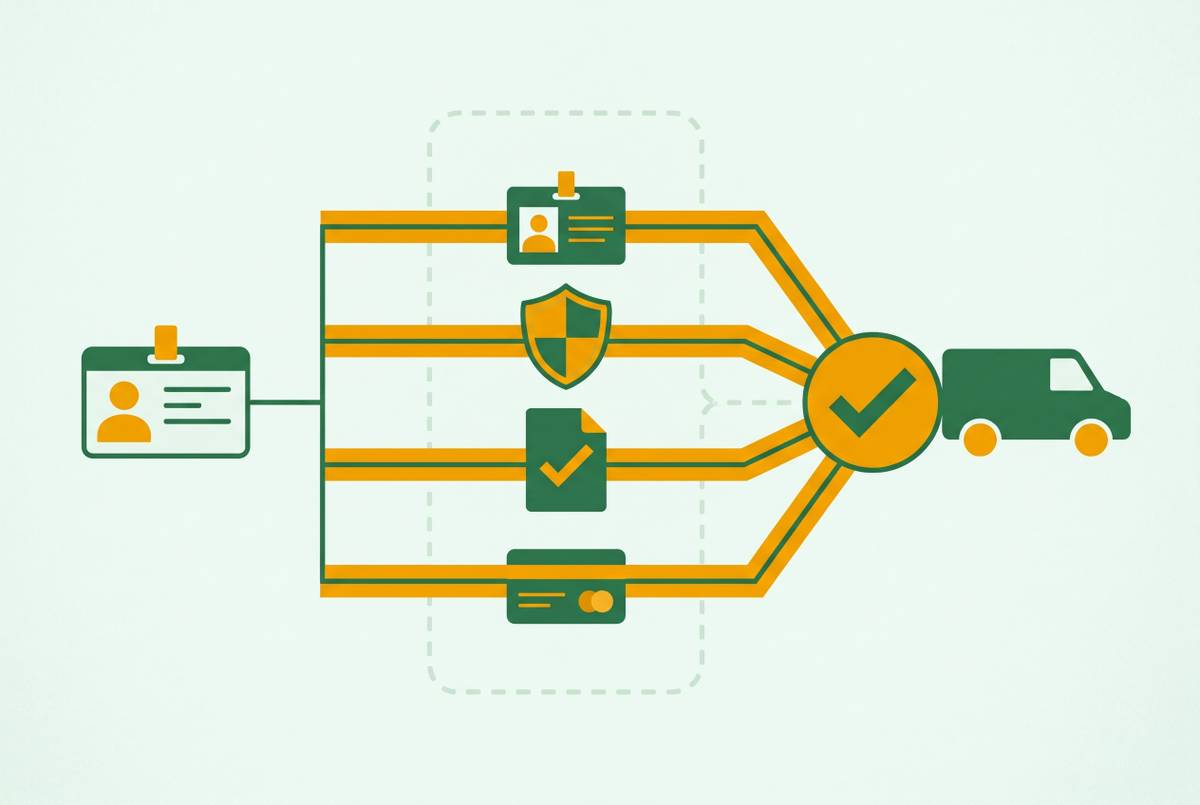
The remedy is a unified onboarding flow. It verifies taxpayer identification numbers through TIN checks and performs know-your-customer, or KYC, checks in real time. It also collects and validates Form W-9 for U.S. persons or the appropriate Form W-8 for foreign persons before any payment is initiated. The operating rule is “no valid tax form, no pay.” The higher reporting threshold does not remove this upfront requirement.
Insurance certificates, professional licenses, and vehicle documentation belong in that same flow. Instant settlement through real-time payment rails then allows readiness and the pay path to be confirmed in the same session. This is contractor onboarding compression in practical terms.
Operators onboarding more than a handful of contractors per month, chasing missing forms, or spending substantial weekly time on verification and payment setup are already beyond the point where manual processes are cost-effective. The relevant comparison is therefore not simply software against staff time. It is a connected activation process against one that leaves completed identity checks stranded behind unfinished credentials or payment setup.
The four-layer insurance stack a 1099 delivery network must have in place before a contractor can go out
Insurance is an activation gate. The four types of coverage to check are occupational accident insurance, commercial auto liability, cargo insurance, and the personal auto exclusion. None substitutes for another. A contractor who is credentialed and payable still cannot safely go out while the relevant coverage remains unresolved.
The first gate is occupational accident insurance, or OAI. It covers medical expenses, disability income, and accidental death and dismemberment up to defined policy limits, at roughly a third less than equivalent workers’ compensation coverage. California’s Proposition 22 requires network companies to provide OAI for app-based drivers while online to operate beyond 90 days, with specified medical and disability minimums. However, platform OAI policies typically cover injuries only during active delivery, leaving gaps between deliveries, between apps, or after logout. The activation decision must establish the actual covered period, especially where pay-as-you-go insurance follows active dispatch periods.
The second gate is commercial auto liability appropriate to the vehicle. Cargo vans, sprinters, and heavier box trucks have different premium profiles, so vehicle-class documentation is an input to the coverage decision. A generic insurance certificate is not enough. The third gate is cargo insurance in force for the goods being delivered. Platform commercial auto liability must not be mistaken for cargo protection.
The fourth gate is the personal auto exclusion. Personal policies exclude commercial delivery use, while Period 1, when the app is on and the driver is waiting for an order, has minimal or no platform coverage. Verifying appropriate commercial coverage belongs in credentialing, rather than resting on the assumption that a personal policy or platform policy fills every gap.
Bulk purchasing can remove part of this uncertainty. Negotiating group OAI and commercial auto coverage gives the operator a structural cost advantage while reducing dependence on each contractor sourcing coverage separately. If the platform provides coverage, it controls when that coverage is confirmed. That gives the operator more control over when a contractor is ready to go, but it still needs to confirm that the contractor can be paid.
Payment infrastructure as the retention layer that determines whether activated contractors actually show up
A contractor cleared for dispatch may decline the next engagement because payment on the last one was slow or uncertain. Fuel, vehicle maintenance, and daily expenses do not wait for a standard ACH batch. Consequently, slow payment can become a capacity failure even when every other readiness requirement has been met.
Same Day ACH processed 403 million payments in Q1 2026, showing that faster ways to pay are available and that more people are using them. Operators that use standard multi-day ACH compete for contractors who can get instant debit or same-day ACH elsewhere. An activated pool is less dependable when contractors have reason to prefer a faster-paying alternative.
To make payment part of readiness, operators should collect and verify bank account or debit card details during onboarding. RTP or FedNow can support real-time payment, while Same Day ACH provides a same-day option. Instant debit push should also be available for contractors who need funds immediately after a shift. Payments should be triggered when a delivery or shift ends.
The tax-form gate connects this payment layer to credentialing. An incomplete form should stop a contractor before the payment queue, rather than create a payment that must later be reversed or reported incorrectly. At hundreds of monthly payouts, automation also saves meaningful administrative time. It does more for operations by making payments consistent, which helps keep contractors in the pool between peaks.
Real-time compliance monitoring as the difference between a readiness checklist and a readiness system
An onboarding record describes readiness at a particular moment. Credentials expire, insurance lapses, and engagement terms change afterward. A quarterly review can therefore be accurate when completed and useless on activation day. The gap opens between checks.
Real-time monitoring addresses that gap by following the conditions that make a contractor field-ready. An insurance certificate may expire before peak, while a driver’s license or vehicle registration may lapse after onboarding. Changes in hours, exclusivity, or control can also raise classification questions that the original review did not resolve. These are changes to dispatch eligibility.
Payment totals can cross the 1099-NEC reporting threshold earlier than expected, requiring attention to reporting obligations and the validity of tax documentation before the next payment. State developments such as the Kansas benefits provision and Washington’s contingent enforcement powers can also affect existing engagements. For a multistate network, monitoring must distinguish applicable changes from rules that do not govern a particular contractor.
Operators can identify which contractors are field-ready and which have an unresolved gap on the day capacity is needed. That distinction becomes especially valuable at peak. Re-verifying a hundred contractors on surge morning consumes hours that a network with current readiness information can instead use to dispatch.
Building the pre-peak readiness checklist — what to verify, in what order, before the surge hits
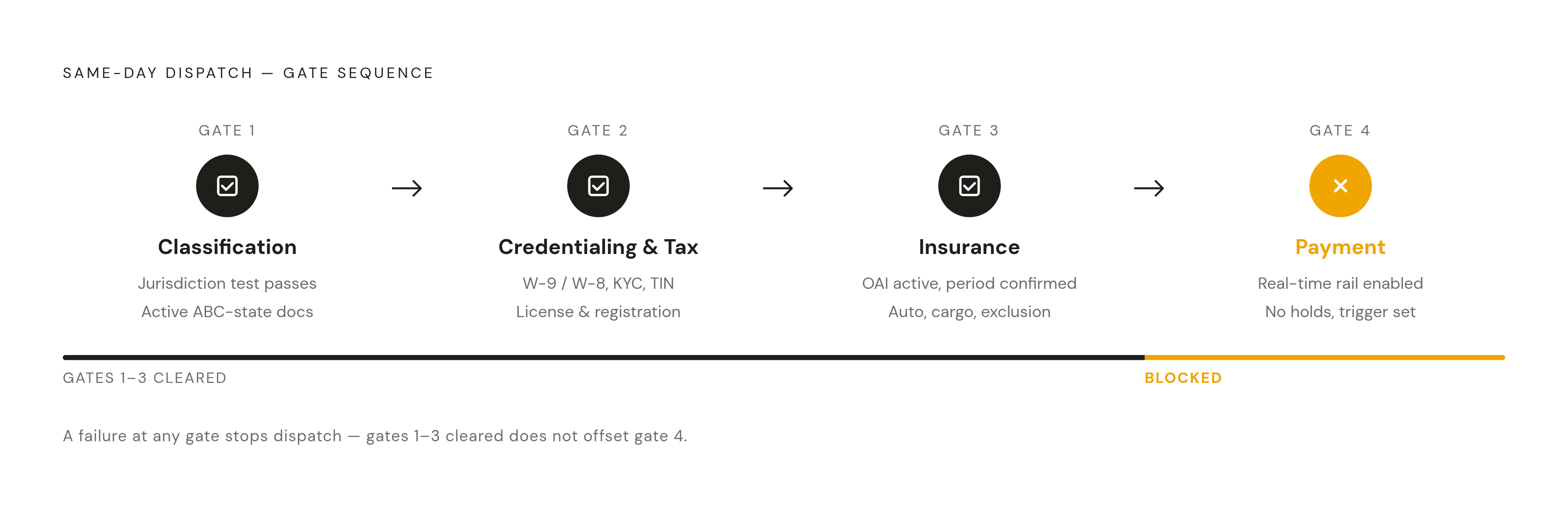
The pre-peak sequence starts with classification because the remaining checks cannot repair an indefensible relationship. Operators should confirm that each engagement passes the applicable test in every jurisdiction where the contractor operates, with active documentation in ABC test states. They should also check the current 1099-NEC filing status and flag changes in state rules that apply. This establishes the foundation for the activation decision.
Operators should check that the contractor has a valid tax form, that KYC and TIN verification is complete and current, and that bank account or debit card details have been verified. Driver’s licenses, vehicle registrations, and insurance certificates need expiration checks.
OAI must be active, and operators must know when it covers the contractor and whether any policy or platform protection covers the waiting period. Commercial auto liability must suit the vehicle class, and cargo insurance must cover the goods being delivered. A personal auto policy on its own does not cover delivery work.
Payment readiness follows with a contractor-specific check. Operators should confirm an enabled real-time or same-day payment rail, a trigger tied to delivery completion or shift close, and no holds or documentation gaps that would block first-shift payment. The final monitoring check should establish that credentials were re-verified within the monitoring window and that no unresolved alerts remain in any applicable jurisdiction. Monitoring must also flag lapses during peak.
A standing ready pool can be dispatched in minutes while an unprepared operation is still re-verifying contractors. Compliance infrastructure becomes usable capacity. That is the competitive advantage of same-day readiness, built before anyone needs it to be same-day.